
Food service management software, often searched as just food service software, is a category name that covers half a dozen different systems, and the fastest way to buy the wrong one is to treat it as one thing. This guide is for the multi-unit operator: the enterprise foodservice operator running dining and catering across many sites, whose real question is not “which platform does everything” but “which system is the record for each fact, and does everything else read from it.” That framing comes out of our guide to what a catering management system actually needs to do, and The Catering Operations Playbook covers the operational side in full, free, with no sign-up.
TL;DR
- The stack, mapped: what an enterprise foodservice operation actually runs on, and which layer does what.
- One system of record per fact is the principle that decides the stack; a platform should be able to say plainly where it stops.
- “Unified everything” is usually the wrong buy for a multi-unit operator, and the reason is multiplication.
- Agilysys, Oracle, and Toast are each built around a different center; three things to ask any of them to show in a demo.
- Build vs buy comes down to one question: are you a technology company, or a foodservice brand with technology capabilities?
- Ten questions for the first vendor meeting, each telling you something specific.
- Where App8 fits, plainly: the one claim we stand behind, and the buyers we send elsewhere.
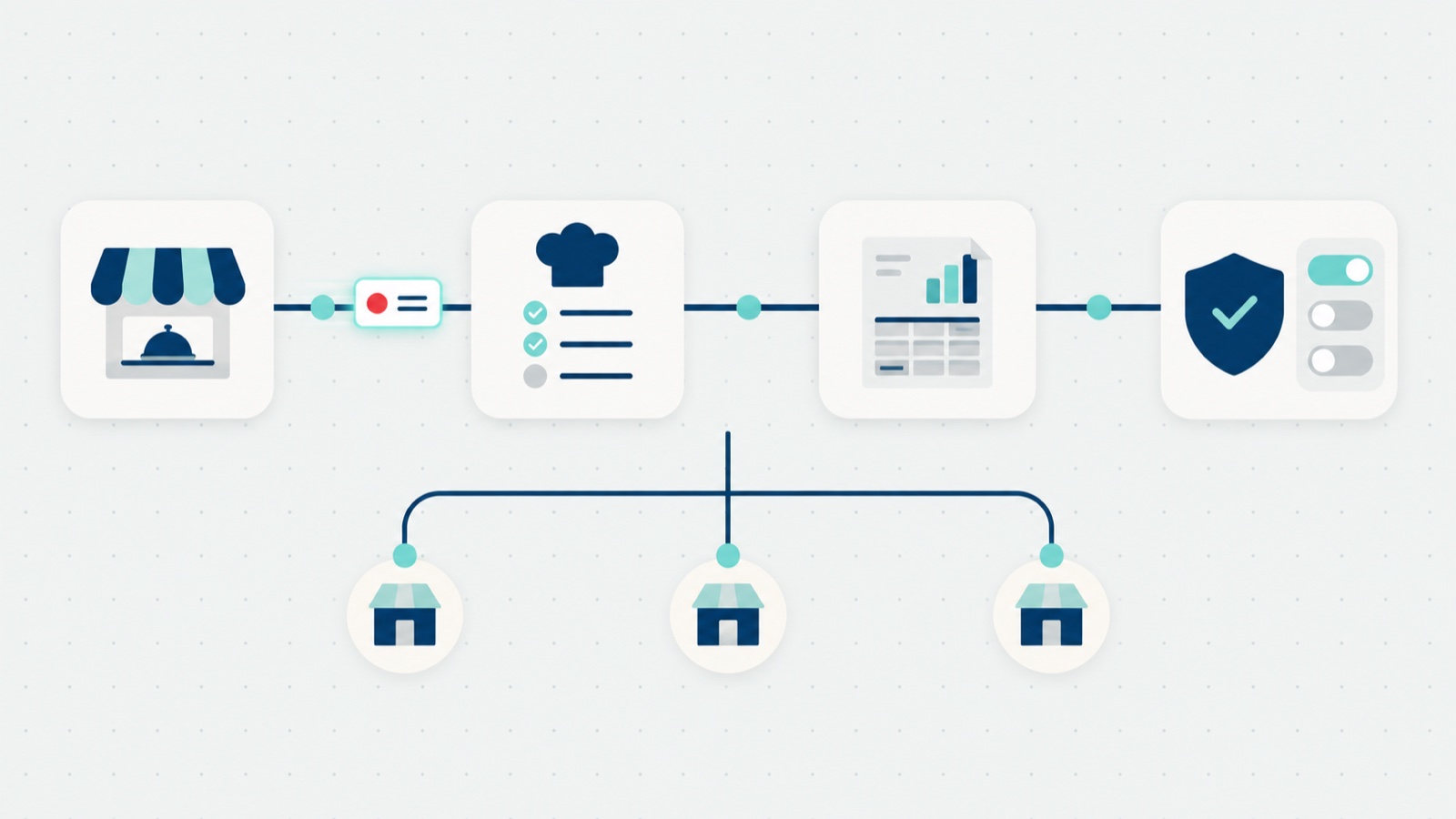
The operator’s stack, mapped
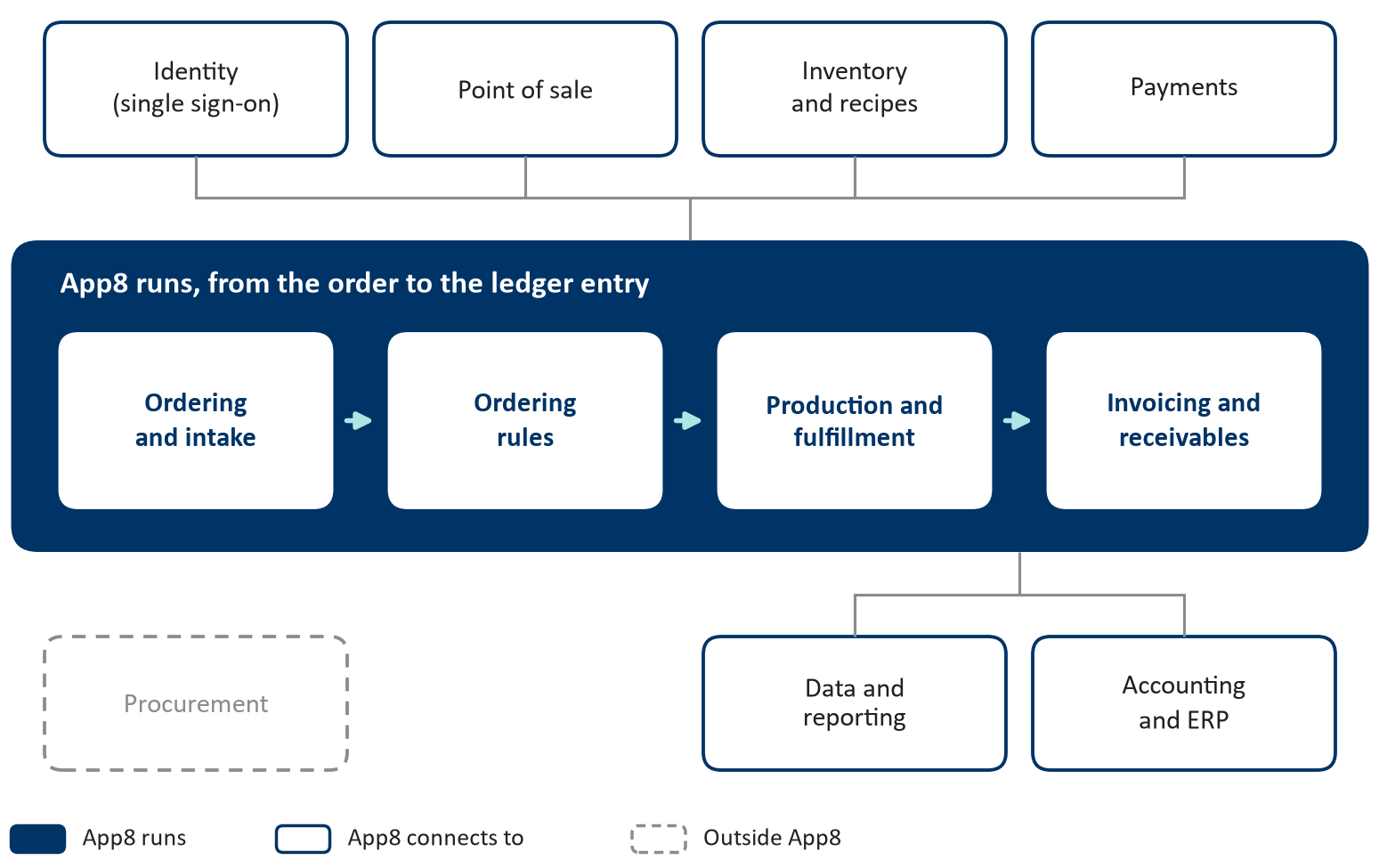
The same picture as a table, layer by layer:
| Layer | What it covers | App8’s part |
|---|---|---|
| Ordering and intake | Catering, school, and on-site orders from every channel | Runs it: one ordering channel per site, up to 15 custom questions at checkout, plus orders staff enter from phone and email |
| Ordering rules | Lead times, cutoffs, minimums, blocked dates | Runs it: set once centrally and inherited by every site, while sites keep their own hours, closed dates, delivery locations, and fees |
| Production and fulfillment | Production sheets, packing lists, labels, delivery details | Runs it: generates them from the accepted order |
| Invoicing and receivables | Invoices, payments, reminders, receivables | Runs it |
| Identity | Staff and client sign-in | Connects through single sign-on, case by case |
| Point of sale | Sales rung up at the counter or terminal | Connects to it. App8 is not a point of sale |
| Inventory and recipes | Stock, recipes, costing, nutrition | Connects where the operation needs it |
| Payments | Card processing and payouts | Connects to the processors the operator already uses. App8 is PCI DSS Level 1 |
| Data and reporting | Enterprise reporting and data platforms | Reports on its own orders, and can send order and revenue data into the operator’s data environment |
| Accounting and ERP | The general ledger and chart of accounts | Posts into it. The ledger stays with finance |
| Procurement | Buying from suppliers | Outside App8 |
Where App8 stops matters as much as where it runs. It does not ring up sales at a terminal, keep the general ledger, buy from suppliers, count stock, or cost recipes. It is software an operator runs, and it does not bring in orders from a marketplace.
One system of record per fact
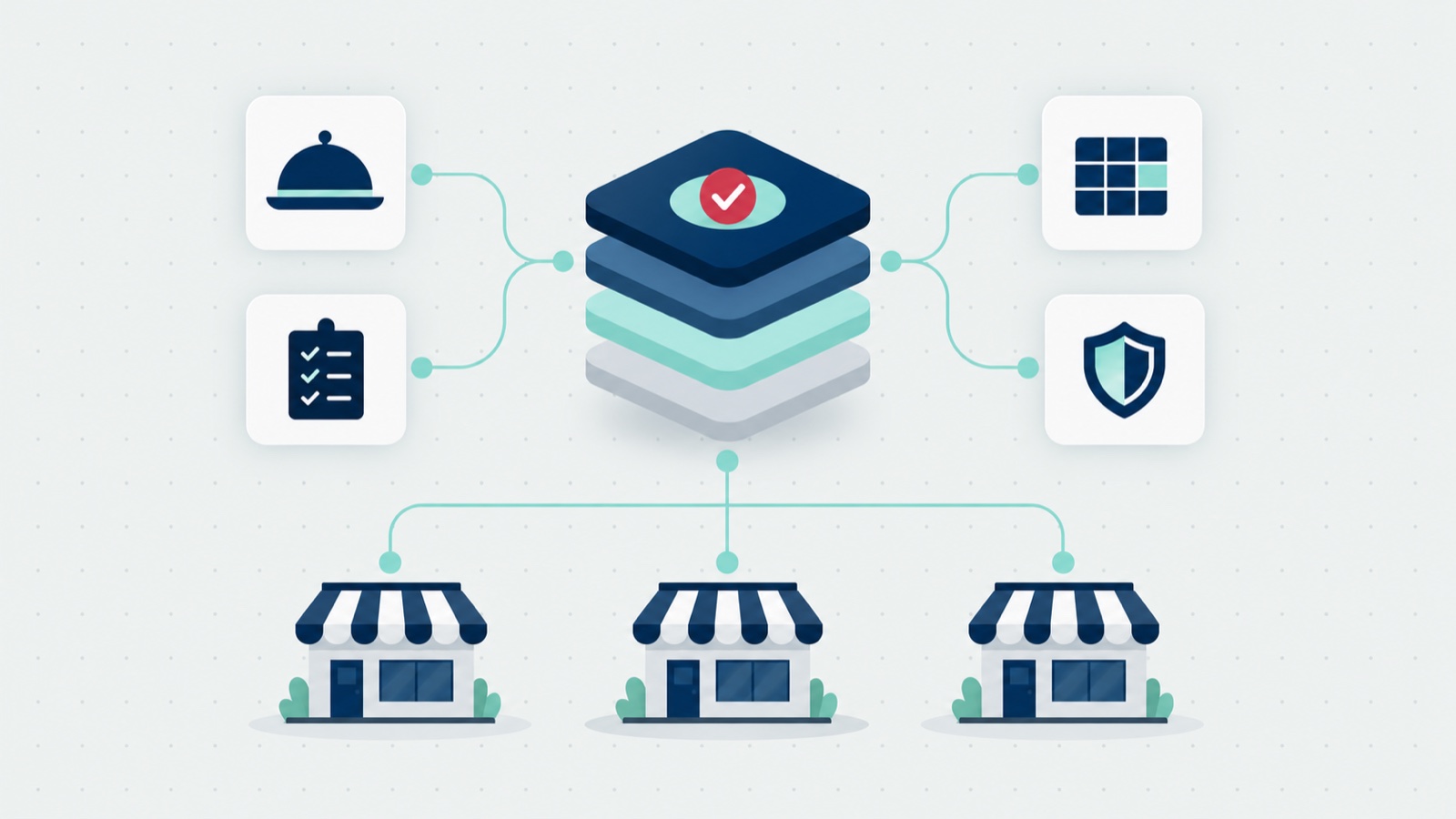
The principle behind that split: each fact has one system of record. The point of sale is the record for an item as the cashier rings it up. App8 is the record for what can be ordered in each channel and at what price, and for the catering cutoffs, capacity, and production. The ledger is the record for the books. Every other system reads from that record.
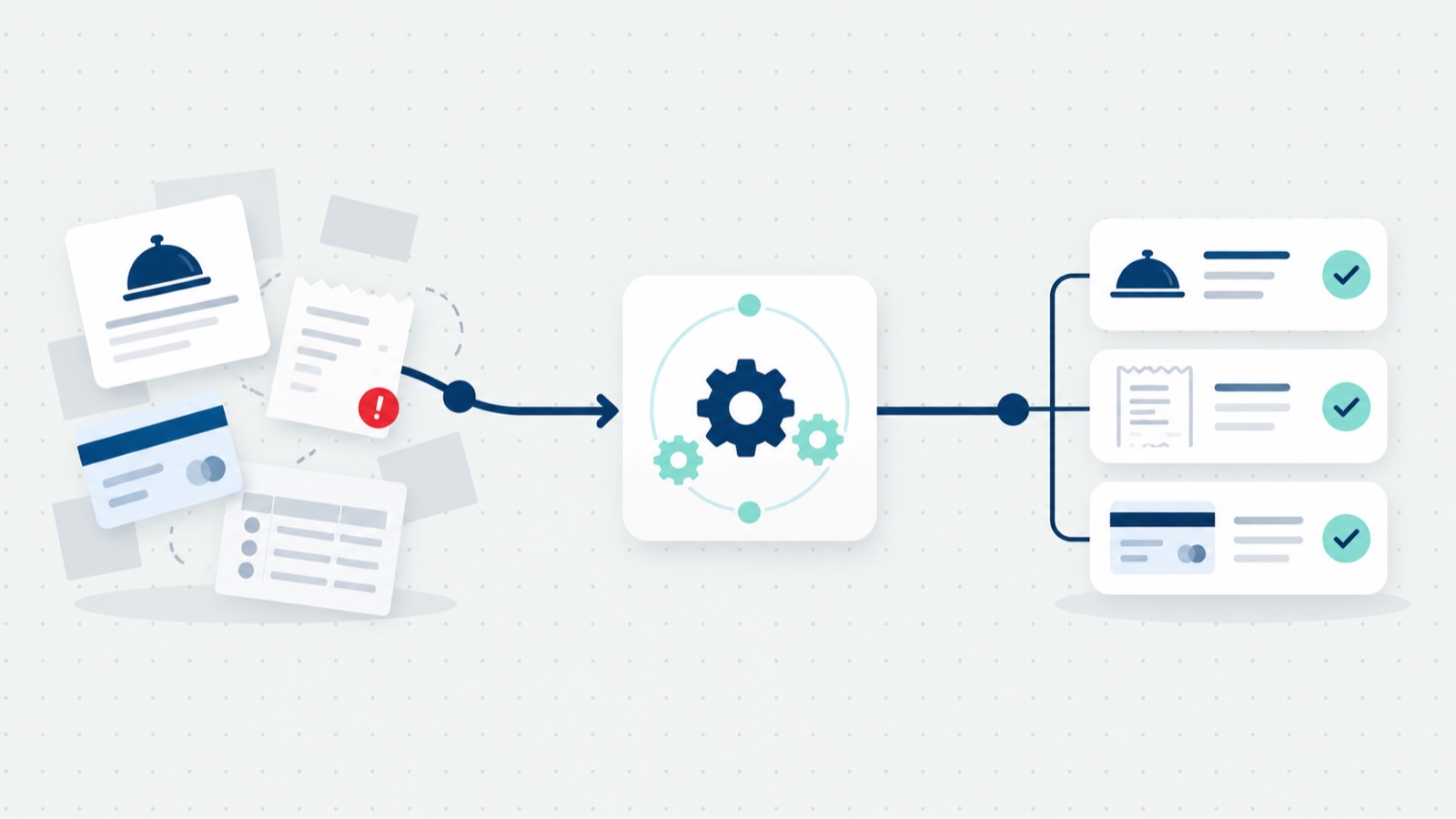
Buy against that principle and vendor conversations get simple. A platform that wants to be a second source of truth for a fact another system already owns is not adding capability; it is adding reconciliation. The order to the ledger path is the clearest example: an invoice that cannot reach the ledger gets re-keyed, however good the tool that produced it.
Is unified everything the right buy?
Usually, no. For a single site it can make sense: every additional vendor is a relationship someone has to manage, and there is no team to manage it. For a multi-unit operator, the math flips, for one reason: multiplication. A technology or process that does not fit the business is multiplied by the number of sites, and inconsistency adds its own cost when results consolidate upward.
Three things follow:
- The systems of record are already in place. The ledger, the point of sale, and the identity directory already run across the group, and catering can change without replacing them. The brief to IT and finance can say it plainly: no new finance system, no change to the chart of accounts.
- Integration has a cost too. Every connection needs an owner, a test, and a plan for when it fails. Put the deep connections where the orders and the money move.
- Multi-unit management is its own capability. Bulk modifications, whole-menu import and export, real-time edits across the enterprise, menu updates pushed from a master menu, role-based access by level, replication to new sites. These are the capabilities a single-site tool does not carry, however good it is at one site, and they are the ones to test first.
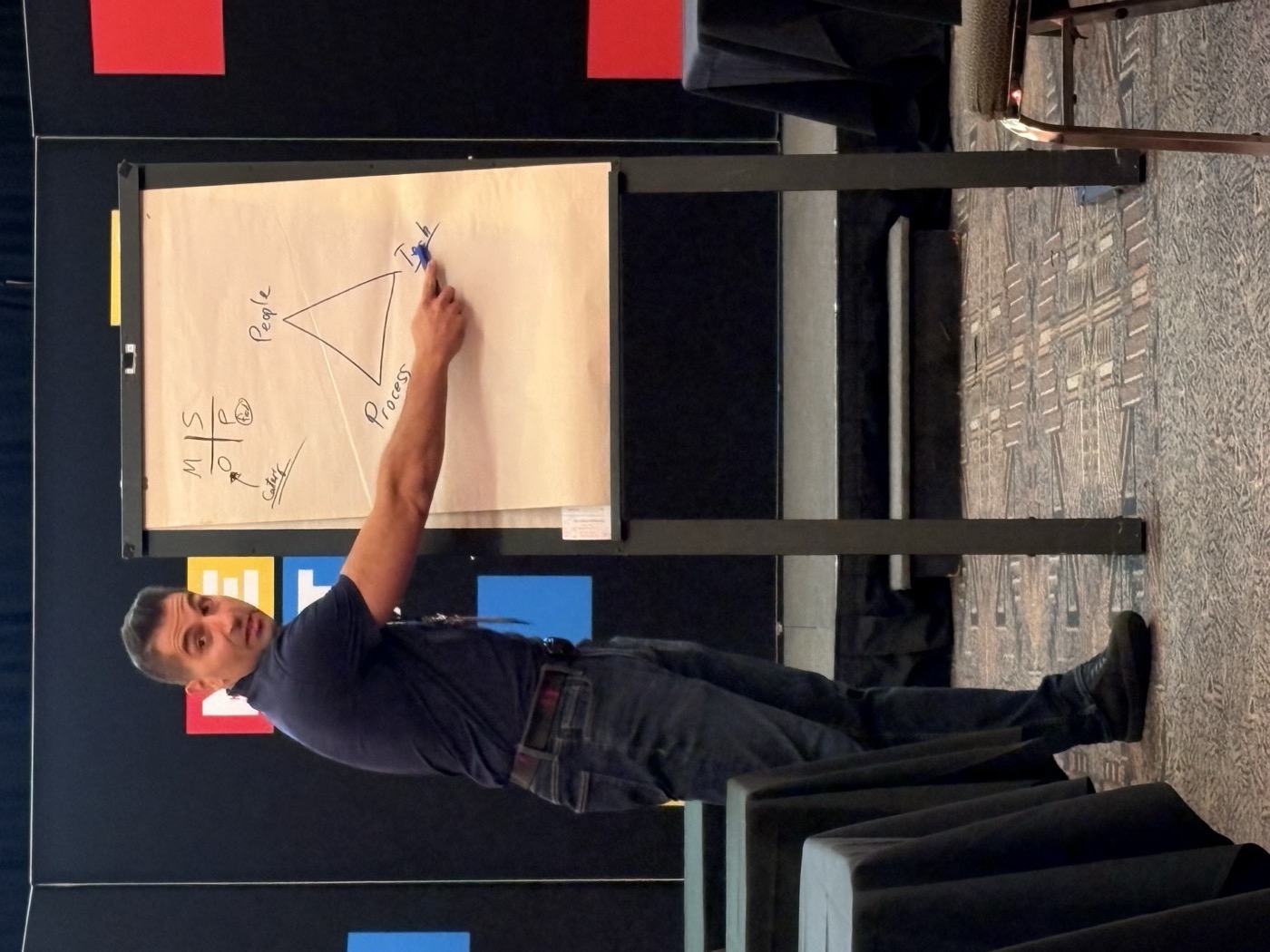
The frame I used on stage at NEXT Food Expo: any operation runs on people, process, and technology, and when the people and the process are unclear, the technology choice goes wrong. Technology fails in two ways. It gets bought as a silver bullet, with no regard for the people and process around it. Or it gets run as a separate budget line, cut off from the operation it is meant to support.
What the big platforms are built around
The large platforms in this category are real products with real strengths, and each is built around a different center. Here is what each one’s own site describes, and where each is strong:
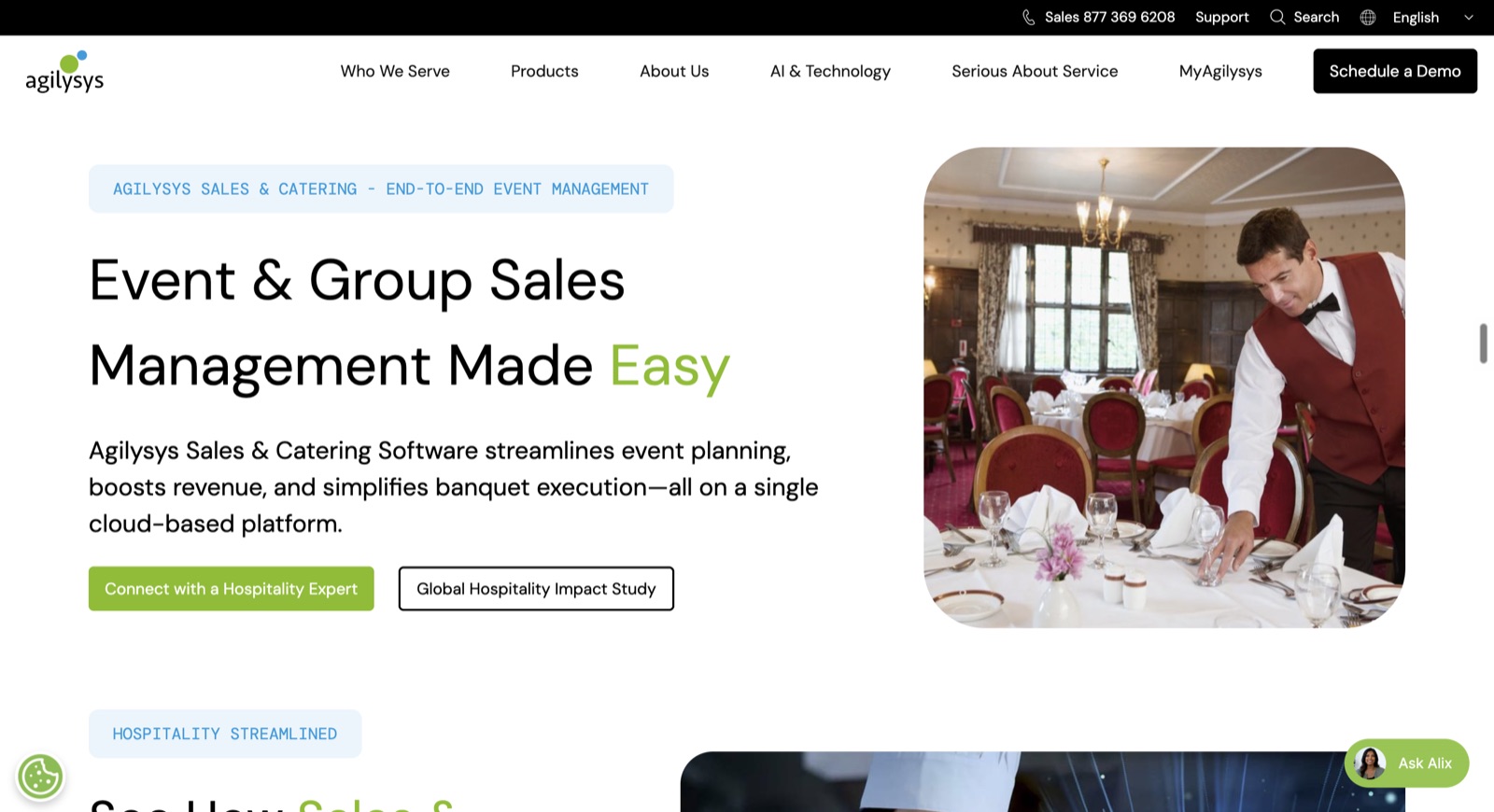
- Agilysys. Sales & Catering is described as sales and catering software for hospitality that helps hotels, resorts, and venues manage meetings, events, and banquets from one platform, with automated banquet event order posting and syncing of InfoGenesis charges to group accounts. Strong at hotel and resort group and event sales.
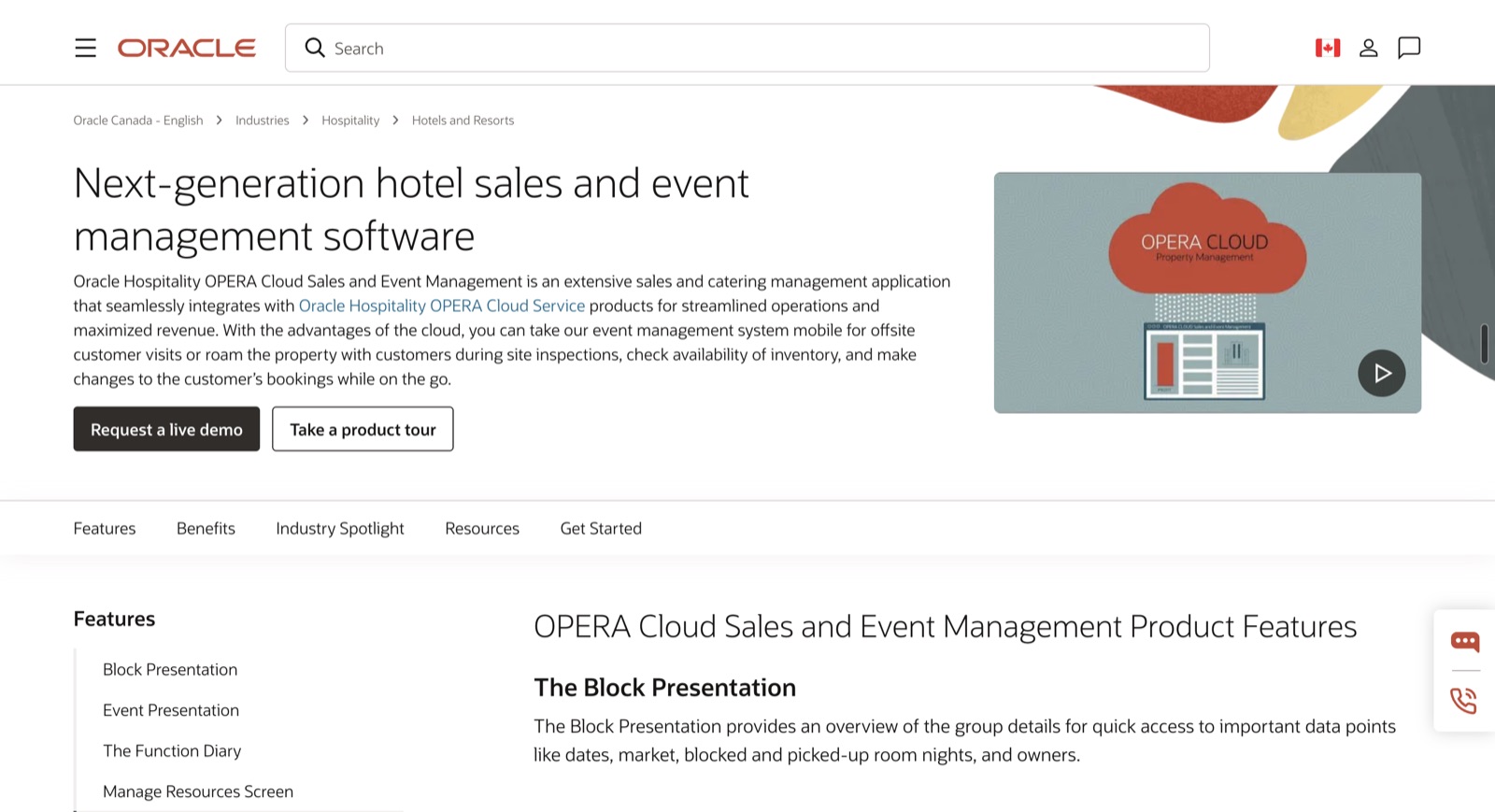
- Oracle. OPERA Cloud Sales and Event Management is Oracle’s sales and catering application for hotels: group rooms, rates and meeting space, a function diary, and catering packages. Simphony is Oracle’s cloud restaurant point of sale, built for quick service, table service, cafes, bars, stadiums, and theme parks, with a large integration ecosystem. Strong at hotel events and at high-volume point of sale.
- Toast. Toast Catering & Events is integrated with the Toast point of sale and pairs with Toast Invoicing to send invoices and collect deposits, for restaurants running catering and events. Strong for a restaurant that wants catering on the point of sale it already runs.
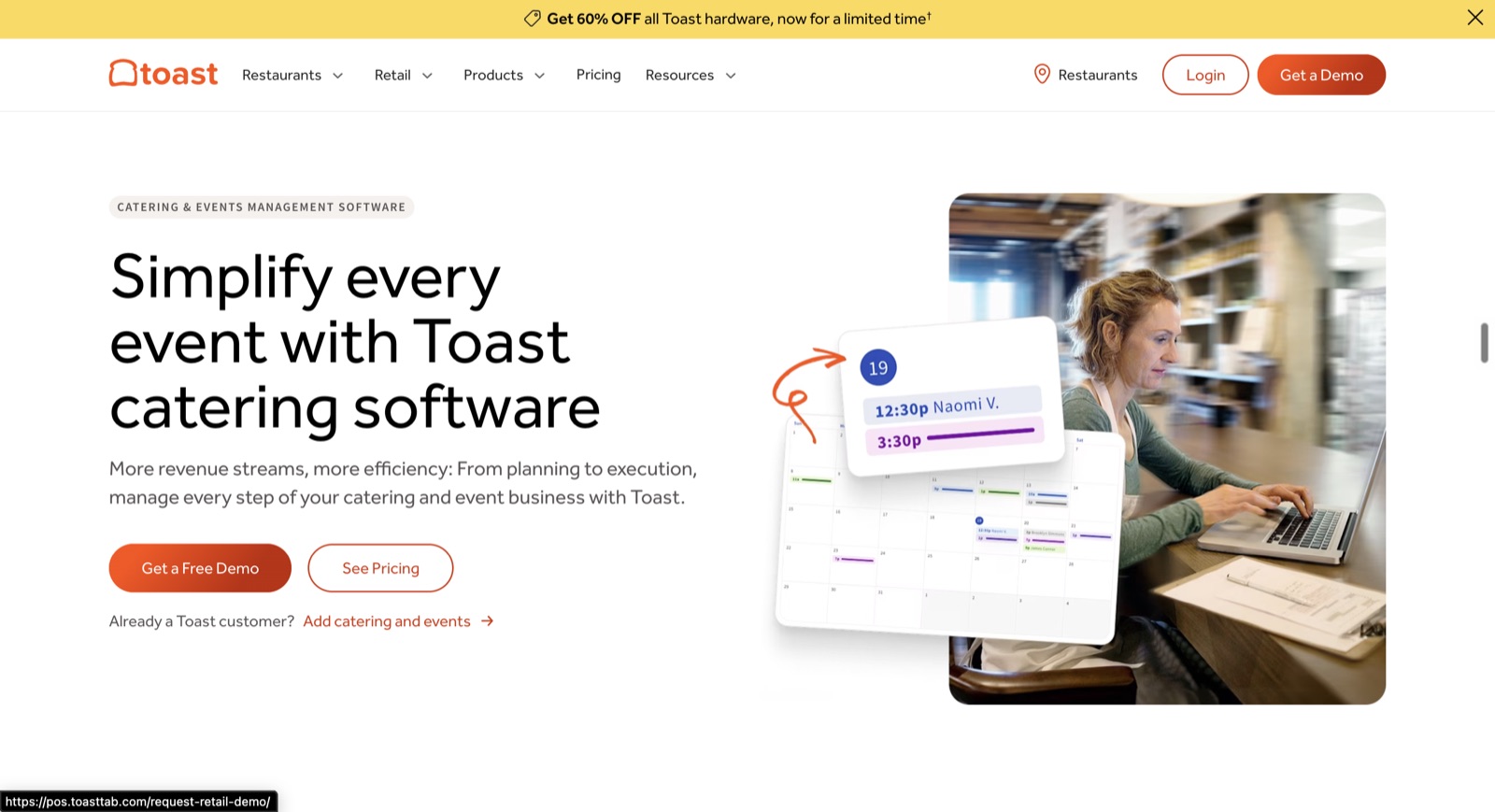
That is what their public pages describe. What a workplace catering program turns on is a different set of mechanics, so whichever platform you evaluate, ask it to show three things in a demo:
- Billing departments by cost center or PO, with the code checked when the order is placed.
- Receivables posting into your own ERP, by site.
- Ordering rules set once for many client sites.
A platform built around a hotel’s event space or a restaurant’s point of sale may do all three, some, or none. The demo answers it; the category name does not.
Build vs buy
Large operators do build their own ordering, and it can be the right call. Build when the software is part of how you compete and you will staff it as a product for years. Buy where a vendor already carries that work across many operators.
Where in-house ordering tends to stall:
- Upkeep outlasts the project. A one-off build needs a team to staff and maintain it long after launch.
- The second site, and the twentieth. Rules, menus, and reporting built for one site need rework to serve many.
- Catering is the hard edge. Late changes, deposits, invoicing on terms, and cost center billing go well beyond a pre-order flow.
- Payments bring yearly obligations. A build that takes cards carries its own PCI compliance work.
- The ledger is its own project. Posting catering receivables into the finance system is a second build on top of the first.
The question that decides it, in my experience, is this: are you a technology company, or a foodservice brand with technology capabilities? Almost every company needs the capabilities. Very few need to be the technology company, staffed with a best-in-class product team maintaining an ordering platform for years. And where an operator has proprietary systems that made building in-house feel necessary, a purpose-built catering layer can connect to those systems instead: that is precisely the job of App8’s enablement team and its repeatable way of building integrations, set out on the approach page. Where an operator already runs its own ordering platform, a purpose-built catering layer can also sit beside it and connect to it.
What to ask a vendor in the first meeting
Ten questions, and what each answer tells you:
| The question | What the answer tells you |
|---|---|
| How do you learn our process before you configure anything? | Whether the vendor builds around your operation or around its own defaults |
| For each fact (the item, the price, the order, the invoice, the payment), which system is the record? | Whether you are buying a second source of truth |
| Can you show one order becoming an invoice and a ledger entry, with a late change in the middle? | Whether order to cash holds up outside the clean case |
| Can you grade every integration we need as live today, an enhancement to be scoped, or one-time integration work? | What is real now and what is a project |
| What does opening a new site take, and what is set once centrally? | What the fortieth site will cost you |
| How is it priced: per site, per seat, or as a share of order value? | Which business you are buying into as volume grows |
| What does our security review get up front: PCI DSS attestation, single sign-on, how card data is handled, how our data exports at the end? | How long the review will take |
| What is the uptime commitment, and what happens on the floor if the network drops mid-service? | Whether the vendor has planned for a bad day |
| Who is our named person, and what is the rollout plan for the first sites? | Who carries the rollout day to day |
| Can you show us a reference at our scale, with usage numbers? | Whether the platform has run at your volume |
The second question is the whole guide in one line. A vendor that can say plainly which facts it is the record for, and which it reads from your systems, has already understood how an enterprise operation buys.
Where App8 fits, plainly
Having argued there is no single best platform for the whole category, here is the claim we will stand behind: for the layer this guide says decides the buy, the path from the order to the ledger entry in a multi-unit catering and ordering program, Rally Catering is built for exactly that job, and we believe it is the best tool for it. The grounds, each covered above or in a linked post:
- It runs intake, rules, production, and invoicing as one record, and posts receivables into the ERP finance already runs, rather than becoming a second source of truth.
- It says plainly where it stops: not a point of sale, not a ledger, not procurement, not a marketplace.
- Multi-unit management is native: rules set once and inherited, master menus, bulk actions, role-based access.
- The commercial model is a fixed annual fee per site, with no per-seat pricing and no commission on order value.
- App8 is PCI DSS Level 1, and its enablement team builds the connections each environment needs, which is often what decides enterprise deals.
If your constraint is a different layer, a point of sale, procurement, inventory, this is not your vendor, and the guide above should help you name the right one. If it is catering and ordering across sites, talk to us and ask us the ten questions.
Where to go from here
Start by scoring your own operation before scoring vendors: the catering scorecard places your program on the five-stage maturity model in 90 seconds, and The Catering Operations Playbook carries the full worksheet, free, with no sign-up. If catering receivables are the constraint, the catering accounting deep dive is the companion to this guide. And for operators writing the technology section of their own bids, the RFP technology checklist covers the procurement end.
Frequently asked questions
What is the best food service management software for a multi-unit operator?
There is no single best product for the whole category, because it spans point of sale, ordering, production, inventory, payments, and accounting, and an enterprise operation assigns each fact one system of record. The buying question is which layer is your constraint. For the ordering and catering layer, from intake and rules through production and receivables posting into the ERP, App8's Rally Catering is built for multi-unit operators specifically; for hotel event sales, Agilysys and Oracle are the established names, and for a restaurant running catering on its existing point of sale, Toast is built for that case.
What is food service management software?
Food service management software is the set of systems a foodservice operation runs on: point of sale for sales at the counter, ordering and intake for catering and on-site orders, production tooling for the kitchen, inventory and recipe systems, payments, reporting, and the accounting system that keeps the ledger. No single product runs all of it well; an enterprise operation assigns each fact one system of record and connects them.
Is food service management software the same as a POS system?
No. The point of sale is the system of record for an item as the cashier rings it up. Catering and advance ordering run on different mechanics: orders placed days ahead, changes before delivery, billing to company accounts on terms, and receivables. Many POS platforms offer catering modules, but the module inherits the POS's same-day assumptions, which is exactly where operators report it breaking.
Should a multi-unit operator buy one platform for everything?
Usually not. The systems of record, the ledger, the point of sale, and the identity directory, are already in place across the group, and catering can change without replacing them. The real question for each fact is which system is the record and whether everything else reads from that record. One system can be the right call for a restaurant or a group whose point of sale already runs everything.
Should a large operator build its own ordering software?
Large operators do build their own ordering, and it can be the right call when the software is part of how you compete and you will staff it as a product for years. Where in-house builds tend to stall: upkeep outlasts the project, rules and menus built for one site need rework to serve many, catering's late changes and terms billing go well beyond a pre-order flow, card payments bring yearly PCI obligations, and posting into the ledger is a second build on top of the first.
How is food service management software priced?
Three models dominate: a fixed fee per site, a per-seat price, and a share of order value. They are different businesses to buy into as volume grows: per-seat pricing taxes adding the people an enterprise program needs, and a share of order value taxes the growth the program exists to create. Ask which one you are buying in the first meeting.