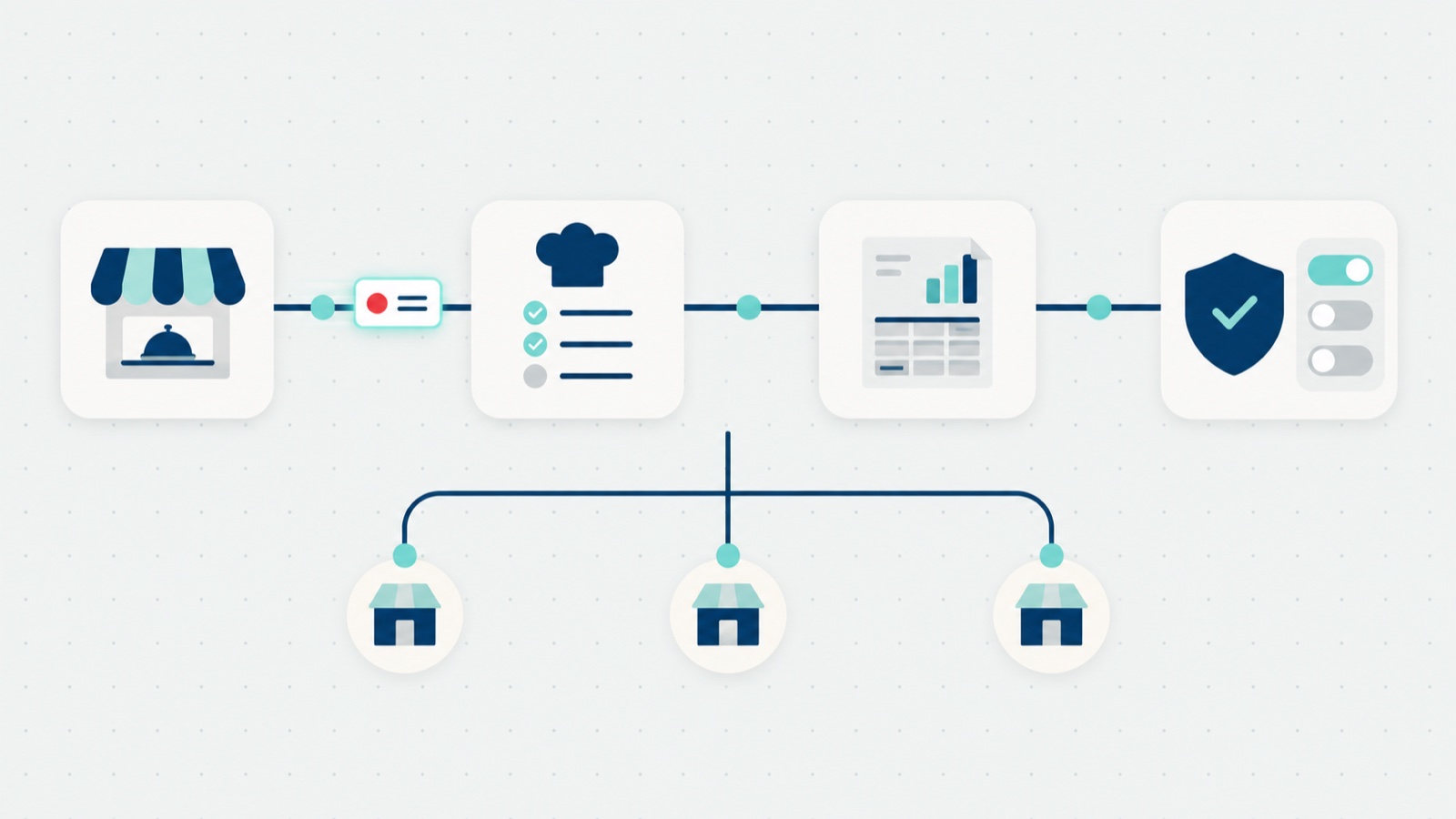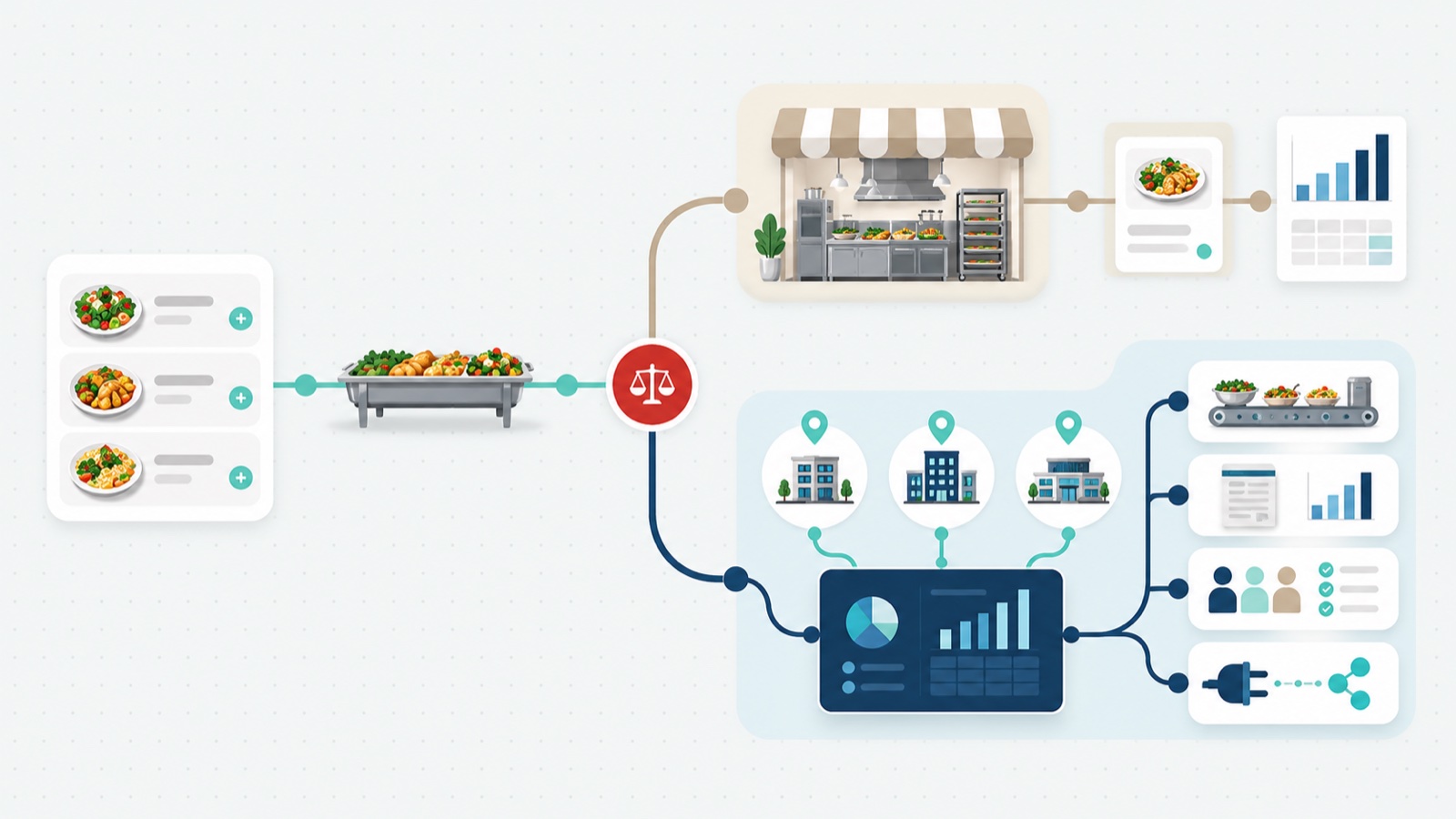


If you are weighing CaterTrax alternatives for a contract foodservice operation, start with the honest fact: CaterTrax is the incumbent for a reason. Its homepage displays Sodexo, Compass Group, Guckenheimer, and Aramark as “CaterTrax powered”, and it publishes real scale: 5,000+ client locations, 5 million+ orders processed annually, 99.99% platform availability. When a platform is the national standard at operators that size, it is in almost every enterprise catering conversation, including ours.
So this is a comparison written by a competitor, and you should read it that way. Two sourcing rules apply throughout. Every CaterTrax fact here comes from catertrax.com, as of September 2026.
And the shortcomings are what enterprise operators running CaterTrax tell us, across several accounts over about two years: they are what operators report, not verified product facts, and any of them may have changed. Where CaterTrax is the better answer, this post says so. The full requirements picture behind the comparison lives in our guide to what enterprise actually needs from a catering management system.
TL;DR
- CaterTrax’s back office is genuinely respected; the criticism operators raise lands on the guest-facing side.
- Operators report five recurring themes: menu changes that are not self-serve, slow change requests, hard reporting, a dated ordering experience, and a French-language gap.
- Five situations where you should not switch, starting with a single site that is not hurting.
- The best CaterTrax alternatives by use case: events products, single-site tools, K-12, marketplaces, and enterprise platforms do different jobs.
- App8 and CaterTrax side by side, row by row, with sources stated.
- One site’s published switching result: orders up 513%, revenue up 526%, with the attribution quoted verbatim.
Our picks at a glance, matched to what you run:
| Best for | Our pick |
|---|---|
| Multi-site B&I and workplace catering | App8’s Rally Catering |
| Weddings and social events | Caterease or Total Party Planner |
| A single-site caterer | Spoonfed, CaterZen, or CaterTrax’s Independent tier |
| Grocery and perimeter-counter foodservice | FoodStorm |
| K-12 school foodservice | Nutrislice, or App8’s Rally Schools for ordering |
| Orders brought to you | ezCater, a marketplace rather than software you run |
| Nothing is hurting | The tools you already have |
Give CaterTrax its due
Five things are worth saying plainly before any comparison.
Its back office is genuinely respected. The consistent read from operators, including ones who later moved to App8, is that CaterTrax’s back-office and operational tooling is strong and they like working in it. The criticism lands on the guest-facing side, not the operator side.
It comes from catering, not from software. The platform was born inside the Rund family’s Rochester foodservice business, a lineage that goes back to a 1906 lunch cart, with the earliest version of the software built in 2000 to run the family’s own catering operation (per a 2019 profile in Software Executive magazine). “Built by caterers” is not marketing spin; it is the company’s actual history, and it is part of why the back office fits how caterers think.
It has depth that comes from being old. CaterTrax has been adding functionality for a long time, and some of that back-office depth is genuinely hard to match. Invoice templates are the example we would give: highly tailored, carrying pieces of information that a newer system built for simplicity does not put in the box. If your operation has been doing something a particular way for fifteen years and needs it exactly that way, that accumulated configurability is a real answer, and it is one a modern product trades away deliberately.
It serves the whole market. CaterTrax sells two published tiers: Independent, for a single location or a small multi-site operation, and Enterprise, for multiple locations and brands that need standardized menus and centralized reporting. App8’s enterprise platform has no independent tier, so for a single-site caterer CaterTrax has an offer where we simply do not.
The installed base is an answer in itself. For a buyer whose first evaluation criterion is “who else runs this”, 5,000+ client locations and four of the largest multi-unit caterers named publicly is a real answer.
What operators running CaterTrax report
These themes come up repeatedly when we talk to enterprise operators who run or ran CaterTrax, including at least one customer’s own written competitive assessment. They are consistent enough that we would stand behind them as a pattern.
Menu changes are not self-serve. The one that comes up most. Units cannot edit menus at their own level, so a price change or a new item goes back to the vendor’s team, and setup and menu changes can carry a charge. Operators tell us the cost of the platform balloons beyond the license fee this way: seats cost money, the support package costs money, and routine changes flow through support.
Getting anything changed takes a long time. Routine requests become tickets. Larger ones become a scoping exercise, and operators report difficulty getting put in front of the people who would actually make the change.
Reporting is hard work. Straightforward questions like revenue by product type are difficult to answer, and operators end up reporting manually into whatever system finance actually uses.
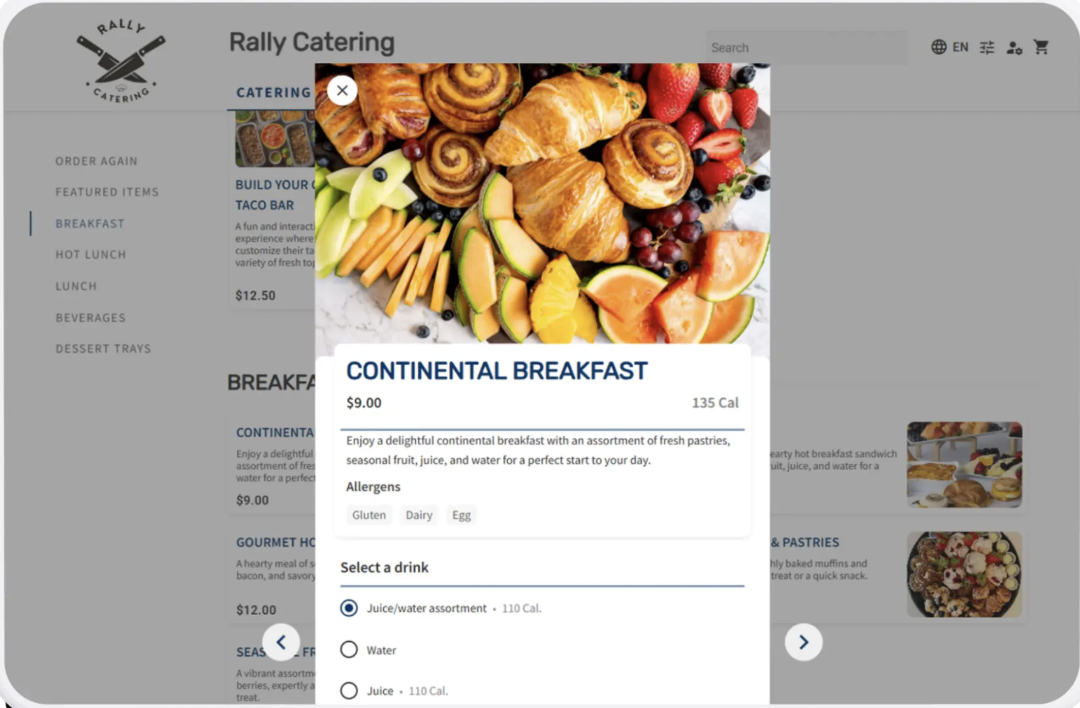
The guest-facing side feels dated. Hold this one more loosely, because it is a judgment rather than a defect, though it is consistent and specific: the back office is respected, and the ordering experience is where the age shows. Rather than assert it, here is a guest-side walkthrough to judge for yourself:
Bilingual and Quebec requirements. French compliance is a recurring gap. For a Canadian operator with Quebec sites, that is disqualifying rather than annoying.
When I would tell you not to switch
An honest alternatives post has to include the cases where the alternative is worse. Do not switch if:
- You run one site, you have no multi-site requirement, and nothing about intake or billing is actually hurting.
- Your work is social events. Weddings and receptions, anything that needs a floor plan or a seating chart, anything where a salesperson builds a bespoke menu and runs a tasting for every booking. App8 is not built for that, and I would not put it in front of you.
- You want a marketplace, meaning orders arriving from someone else’s demand pool. That is a different model, closer to ezCater. App8 is software an operator runs, not a channel that brings orders in.
- You are mid-contract and the pain is a configuration problem rather than a platform problem. Fix the configuration first.
- Your parent operator mandates the platform. Win that conversation before you run a procurement.
The best CaterTrax alternatives by use case
The named products in this category are not interchangeable, and most comparison lists pretend they are. The picks table at the top of this post is the short version; here is the pricing and ratings picture behind it, stated rather than implied, then the honest map product by product.
Published pricing is from each vendor’s own pricing page; where a vendor publishes none, the Capterra listing is cited instead. The prices are deliberately not normalized into one unit: these products charge on different bases, per site, per month plus per seat, or per feature, because they are different products, and inventing a common number would misstate all of them. Compare the pricing model to your operation before comparing the figures. Ratings are Capterra overall scores with review counts, as of September 2026, sorted by rating. ezCater sits out of this table: it is a marketplace, so its pricing and its three-review listing are not comparable with software an operator runs; it is covered in its own section below.
| Product | Published pricing | Capterra rating (reviews) |
|---|---|---|
| App8 | A fixed annual fee per site, users and roles not priced per seat, no commission on order value | 4.9 (10) |
| CaterZen | US$179 to US$229 a month, enterprise by quote | 4.8 (55) |
| Total Party Planner | US$119 to US$429 a month, online ordering module extra, additional users US$25 a month | 4.7 (153) |
| CaterTrax | Not published on its site; Capterra lists US$150 starting, billed per feature | 4.6 (128) |
| FoodStorm | Not published; contact the vendor | 4.5 (19) |
| Nutrislice | Not published | 4.5 (6) |
| Caterease | US$99 to US$199 a month billed annually, plus US$28 a month per additional user | 4.4 (110) |
| Spoonfed | Not published; standard terms run month to month | 4.4 (30) |
Two honest notes on that table. Per-seat pricing appears across most of the category, US$25 to US$28 a month per additional user, which is exactly the model the commercial model section of our requirements guide says to interrogate at enterprise scale. And review counts differ by an order of magnitude: CaterTrax’s 128 reviews reflect its installed base, and App8’s 10 reflect a platform that names no customers and courts few reviewers, so read the counts alongside the ratings, including the row we lead with.
Events-first: Caterease and Total Party Planner
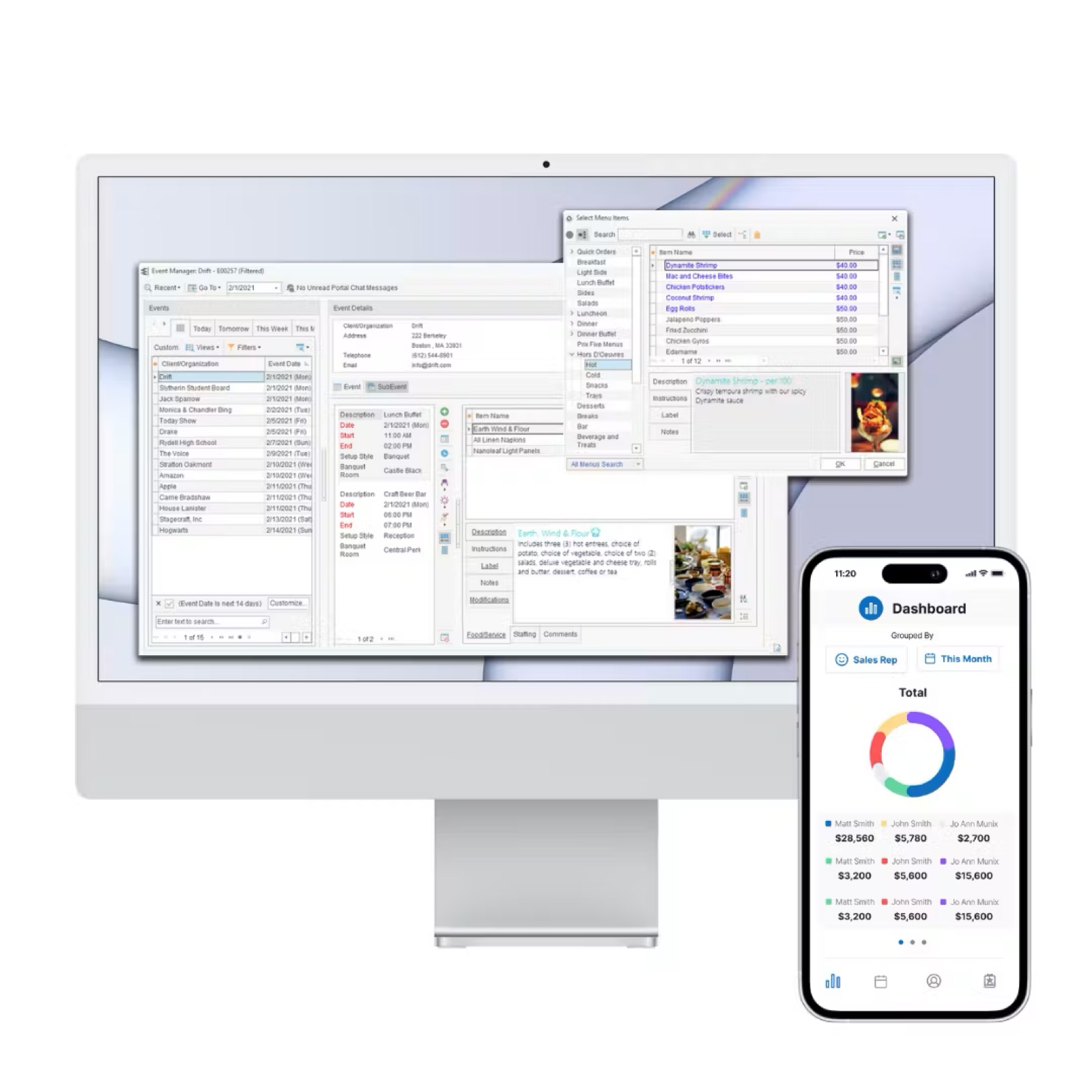
If your business is weddings and social events, where every booking gets a bespoke menu and a tasting, look at Caterease and Total Party Planner. Caterease calls itself an all-in-one solution for catering and event planning, and it connects to floor plan and seating tools such as Social Tables (now Cvent Event Diagramming) and Allseated (now Prismm). Total Party Planner says it lets you organize room layouts. Our full comparison is in Caterease alternatives for multi-site corporate catering.
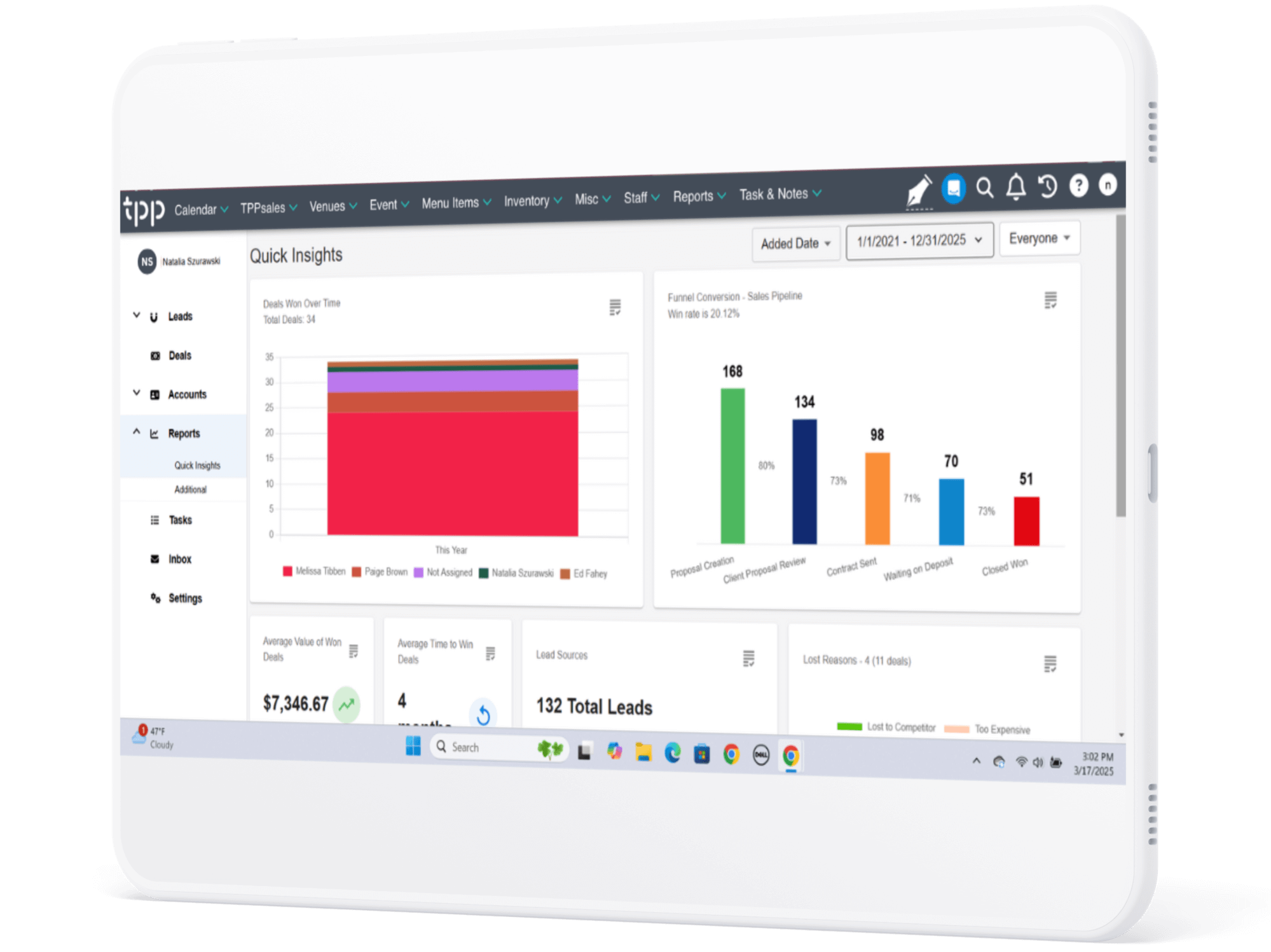
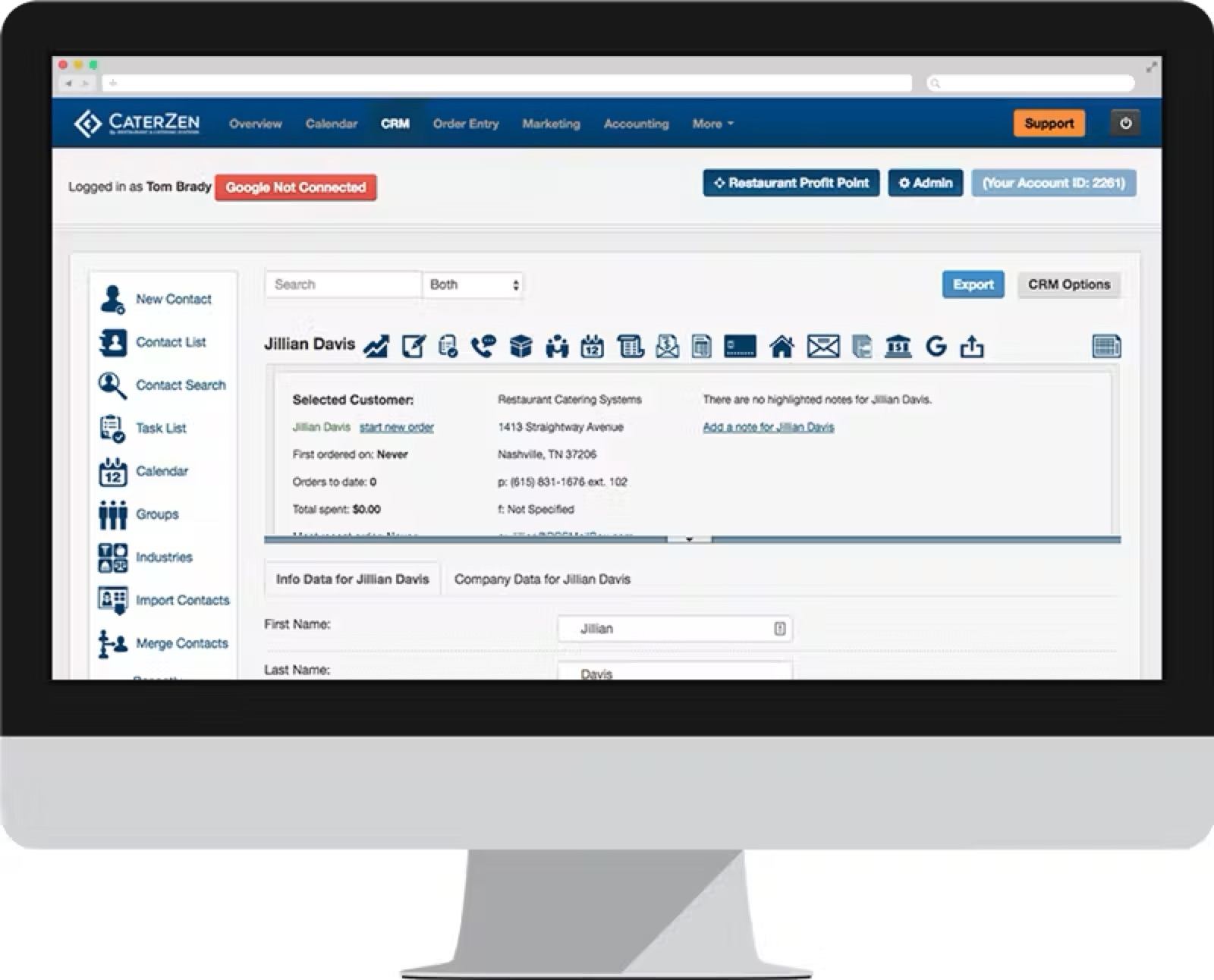
Single-site and SMB: Spoonfed, CaterZen, and FoodStorm
These appear across the category, and they are stronger the closer the buyer is to a single site. A professional caterer can run on one for a while. The breaks come at multi-site reporting, invoicing across locations, and clean receivables, which is where a tool built for one site treats your second site as a copy.
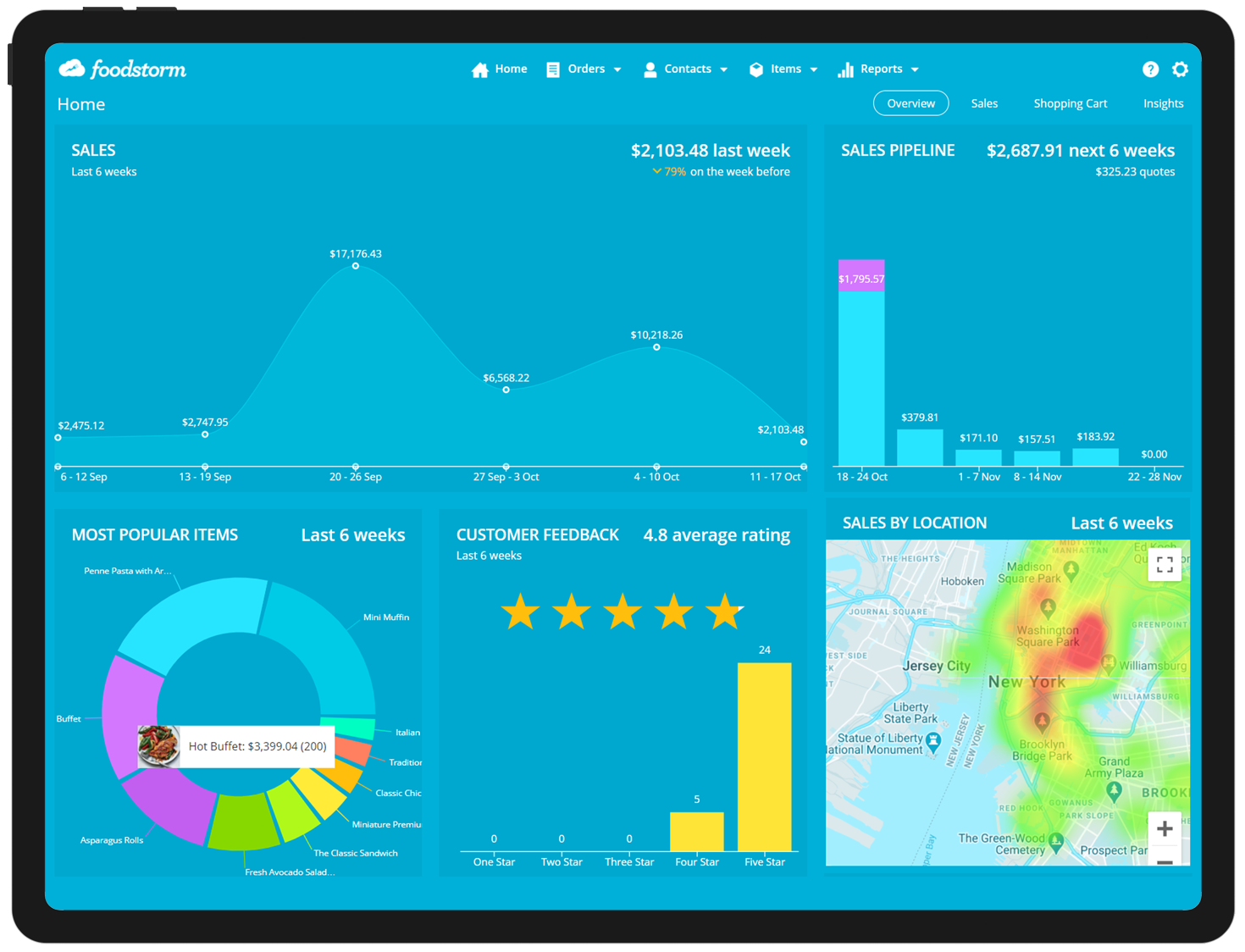
Spoonfed is the one of the three we meet most in enterprise deals, so it has its own alternatives guide, including where it genuinely fits best. FoodStorm, now an Instacart company, has leaned toward grocery and perimeter-counter foodservice, which tells you who it is being built for.
K-12: Nutrislice
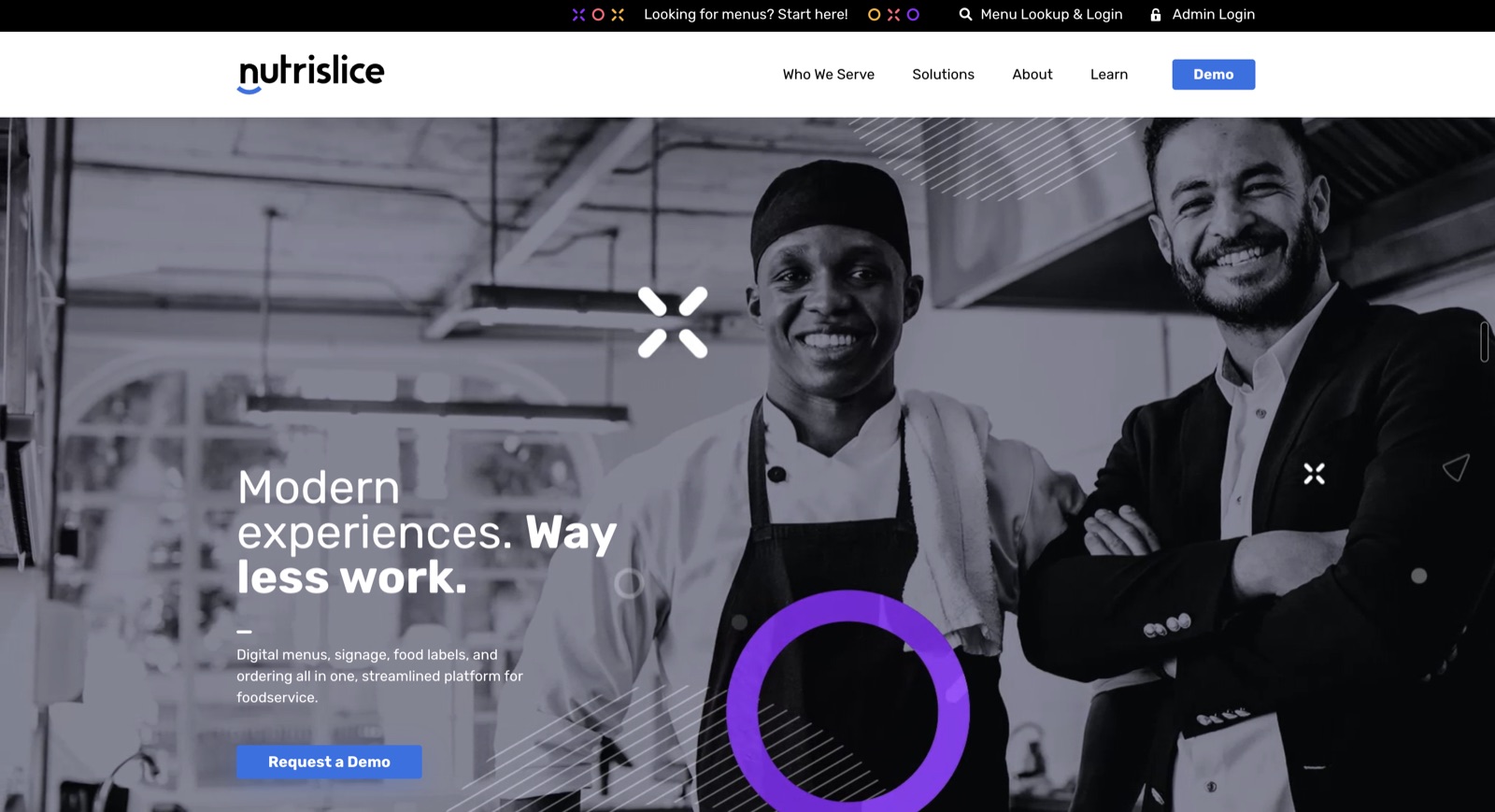
Nutrislice sits on the school side of the category, with digital menus, signage, and food labels for school foodservice. If your program is school meals rather than workplace catering, that is a different evaluation, and we map it in full in our post on school lunch ordering systems. Our own answer there is Rally Schools.
Marketplaces: ezCater
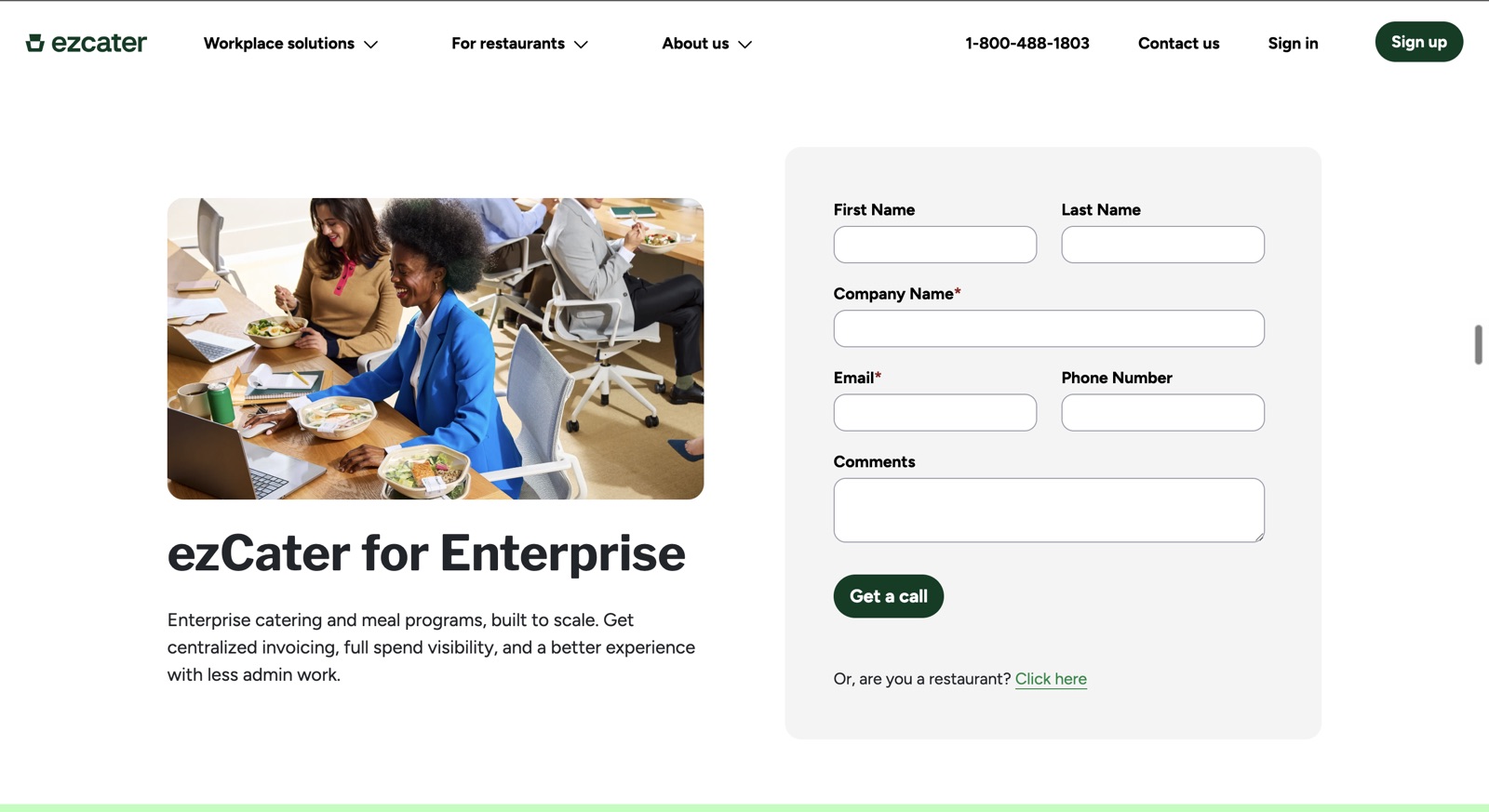
ezCater brings demand with it, which is the point, and takes a different economic shape in return. Its own fee guide states that buyers pay menu prices, delivery fees, and taxes with no platform fees or menu markups, and that each restaurant sets its own order minimums; the operator side of the economics is set with ezCater. If your orders come from your own buildings and your own corporate clients, you are buying software, not a channel.
The tools you already have
Spreadsheets, an existing POS pressed into catering, or something your own IT group built. These win on nothing except already being there, and they lose the moment multi-site reporting or clean receivables is required.
App8: built for B&I catering at multi-site scale
Rally Catering is built for exactly one buyer in this list: the enterprise and multi-location operator running business and industry catering, where the decision turns on multi-site standardization and on catering receivables reconciling into the finance system the operator already runs. That focus is the whole comparison that follows.
What operators tell us actually decides it, beyond the feature list:
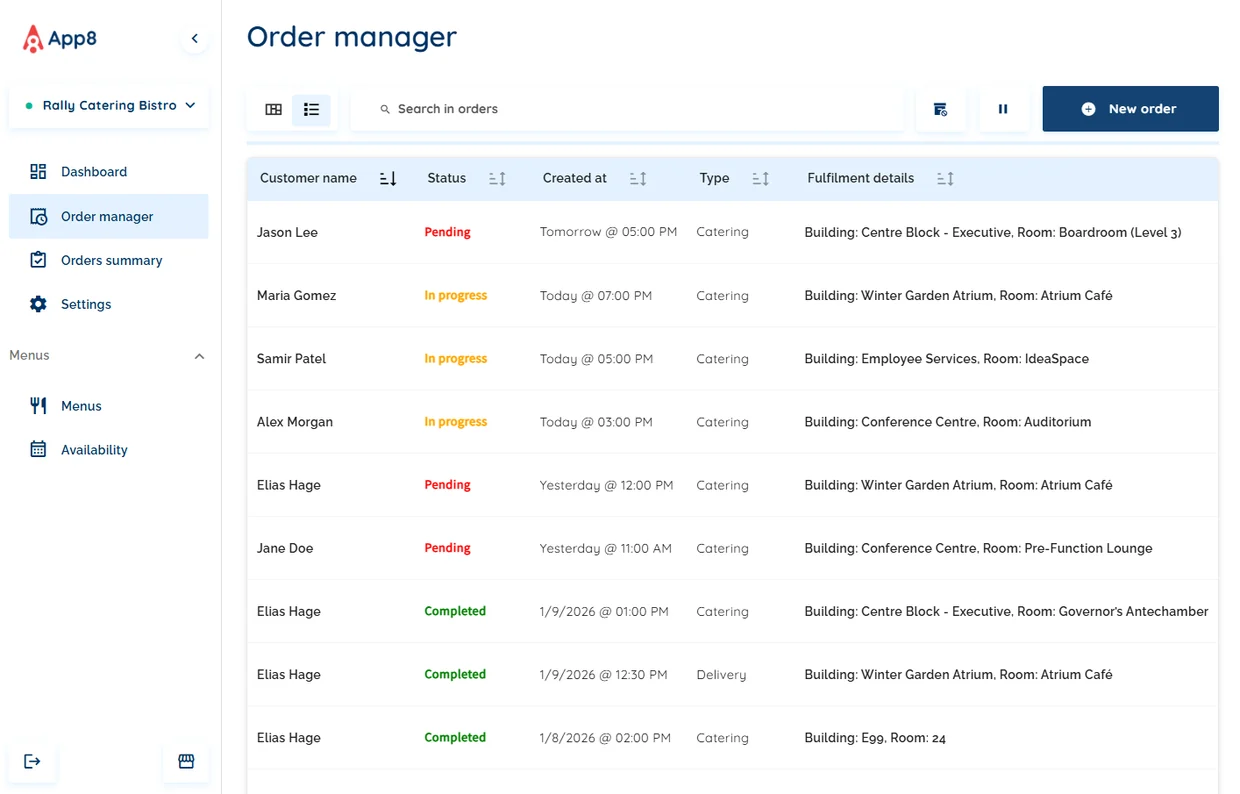
- The order is the single record. Self-serve, phone, and email intake land in one system, and production sheets, labels, and the invoice generate from the accepted order with nothing retyped.
- The intake conveniences that compound. Menu and prices visible before an account exists, up to 15 custom questions answered at checkout instead of by phone tag, and a one-click full-cart reorder, which is what repeat corporate business runs on.
- Money lands where finance lives. The invoice generates on completion, and receivables post natively into the ERP the operator already runs, JD Edwards among them, with cost center and PO codes validated at the point of order.
- The enablement team in the room. Technical people who bring what they have seen work elsewhere rather than only building what was asked, across payments, ERP, identity, POS, and inventory. Operators name this as the reason App8 wins deals against longer feature lists, and it cannot be evaluated from a demo. It is set out on the approach page.
- Implementation is part of the offer. Enterprise onboarding runs on a tailored plan fitted to the operator’s systems and rollout waves, because the platform only matters if the program deploys.
App8 and CaterTrax side by side
CaterTrax facts are from catertrax.com, as of September 2026. App8 facts are our own product and commercial positions. CaterTrax does not publish detail in several of these rows, which is noted rather than held against it.
| CaterTrax | App8 | |
|---|---|---|
| Who it is sold to | Independent tier and Enterprise tier | Enterprise and multi-location foodservice operators only |
| Order intake | Online ordering, customizable menus, event tracking, multi-calendar views | Menu and prices visible before an account exists, up to 15 custom questions at checkout, one-click cart refill from a past receipt, and operator-entered orders for phone and email intake |
| Production | Production management, live order monitor, dynamic reporting | Every accepted order flows to the production sheet, packing list, and labels with nothing retyped; a change reprints what it touches |
| Order to cash | Enterprise tier states integration with POS and finance systems | The invoice generates when the order is marked complete, not when it is placed, and receivables post natively into the operator’s own ERP, JD Edwards among them |
| Cost centers and PO numbers | Enterprise tier states centralized reporting and approvals | Each is validated at checkout against a rule the operator sets; an order carrying a code that does not match cannot be submitted |
| Rules | Standardized menus and pricing at the enterprise tier | Lead time, daily cutoff, minimum order, blocked dates, and the change window set centrally and inherited by every site; the system refuses an order that breaks a hard rule |
| Payments | Not stated on the homepage | Integrated checkout with all card information tokenized; App8 and its payment providers are each certified PCI DSS Level 1 |
| Language | Not stated on the homepage | English and French across the guest menu and the operator dashboard, real translations built for Quebec’s requirements under Bill 96 |
| Commercial model | Not published | A fixed annual fee per site, no per-seat pricing, no commission on order value |
The row we would put first for a B&I program is cost-center payment with validation, because a workplace catering program bills departments, not people. The mistyped-code class of billing error gets removed at the point of order rather than found in reconciliation.
The shape behind the App8 column is one idea: the order is the single record, and everything downstream is generated from it. One ordering channel in. The operator reviews and accepts, production prints from the accepted order, the invoice generates from the completed order and posts to the accounting system, and rules are enforced at order time rather than argued about afterwards.
What a switch produced at one site
One published number, with its attribution stated exactly. A workplace site that moved from manual intake to Rally Catering recorded catering orders up 513%, revenue up 526%, a 70% repeat-order rate, and 67 hours of manual work cut. That is App8’s own record for one enterprise workplace site, anonymized and single-site, over the 12 months to January 2026 against the year before. Repeat orders are orders placed by returning buyers. The manual work is an estimate of about five minutes an order across the orders in the period.
One site is not a fleet average, and we would not present it as one. The full account is in the enterprise workplace catering case study, and the mechanisms behind the growth are broken down in how to increase catering sales.
How to run the decision
Do not start from a feature list, ours or anyone’s. Start from the question that finds the real constraint: if you had ten times the catering volume tomorrow, what breaks first? Intake, the kitchen handoff, invoicing, or rule enforcement across sites. That answer is your priority, and it is the row to weight in any comparison, including this one.
Three resources for the work itself. What enterprise actually needs from a catering management system is the full requirements picture behind this comparison. The catering scorecard places your program on a five-stage maturity model in about 90 seconds.
And The Catering Operations Playbook covers the four jobs a catering operation runs on and what to fix first; it is free, with no sign-up. If receivables and invoicing are what is hurting, the catering accounting deep dive covers the order to cash path in full. For the procurement end, there is an RFP technology checklist on its own page.
And if your evaluation reaches the stage where operators talk to vendors: bring the hard questions from your own operation, ask CaterTrax about theirs, and ask us about ours. A platform decision at this scale deserves both answers in the room.
Frequently asked questions
What is CaterTrax?
CaterTrax describes itself as the market-leading catering and hospitality ordering platform built by caterers. It sells two published tiers, Independent for a single location or small operation and Enterprise for multiple locations and brands, and its homepage publishes 5,000+ client locations, 5 million+ orders processed annually, and 99.99% platform availability, with Sodexo, Compass Group, Guckenheimer, and Aramark displayed as CaterTrax powered (catertrax.com, checked September 2026). The software was first built in 2000 inside a Rochester family foodservice business, and the company has been owned by Volaris Group, an operating group of Constellation Software, since November 2017 (Software Executive magazine, 2019).
What are the best CaterTrax alternatives?
It depends on the operation. For weddings and social events that need floor plans, seating charts, and tastings, events-first products like Caterease or Total Party Planner fit better. For a single site, Spoonfed, CaterZen, and FoodStorm compete in the category. On the K-12 school side, Nutrislice is the named point product, and App8 offers Rally Schools. A marketplace like ezCater is a different model that brings demand with it. For enterprise business and industry catering across many sites, App8's Rally Catering is built for exactly that buyer.
When is it not worth switching off CaterTrax?
Do not switch if you run one site with no multi-site requirement and nothing about intake or billing is actually hurting, if your work is social events that need floor plans and bespoke menus, if you are mid-contract and the pain is a configuration problem rather than a platform problem, or if your parent operator mandates the platform. In that last case, win the policy conversation before running a procurement.
How much does CaterTrax cost compared with App8?
CaterTrax does not publish pricing. App8 publishes its commercial model: a fixed annual fee per site, users and roles not priced per seat, and no commission on order value. Operators running CaterTrax report that seats and support packages carry their own costs, so a fair comparison prices the change process as well as the license.
Does App8 support French and Quebec language requirements?
Yes. App8 serves English and French across both the guest-facing menu and the operator dashboard, based on the browser's default language. The translations are real rather than machine generated, built to meet Quebec's French-language requirements under Bill 96, and the platform handles Canadian and Quebec taxes.