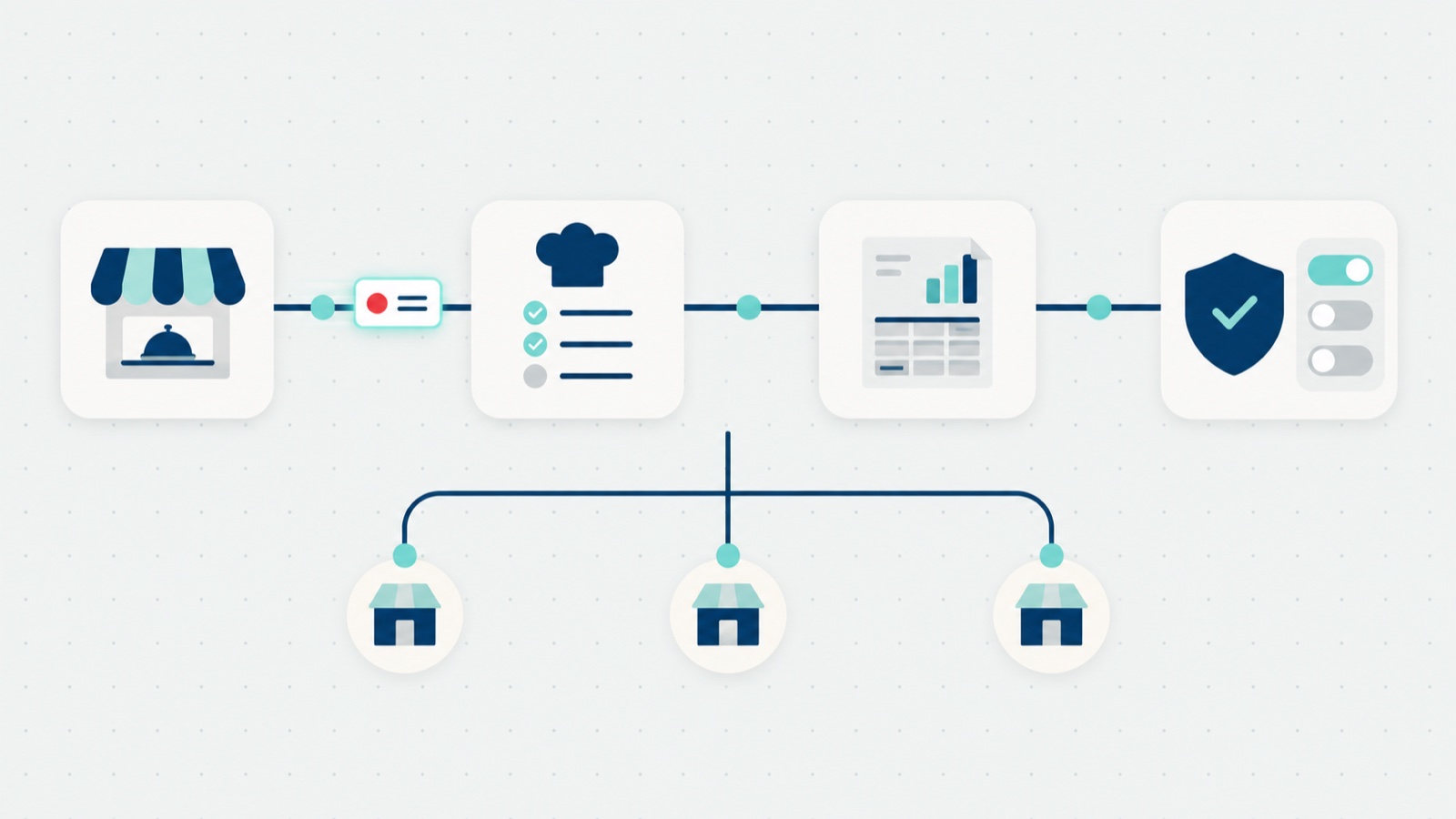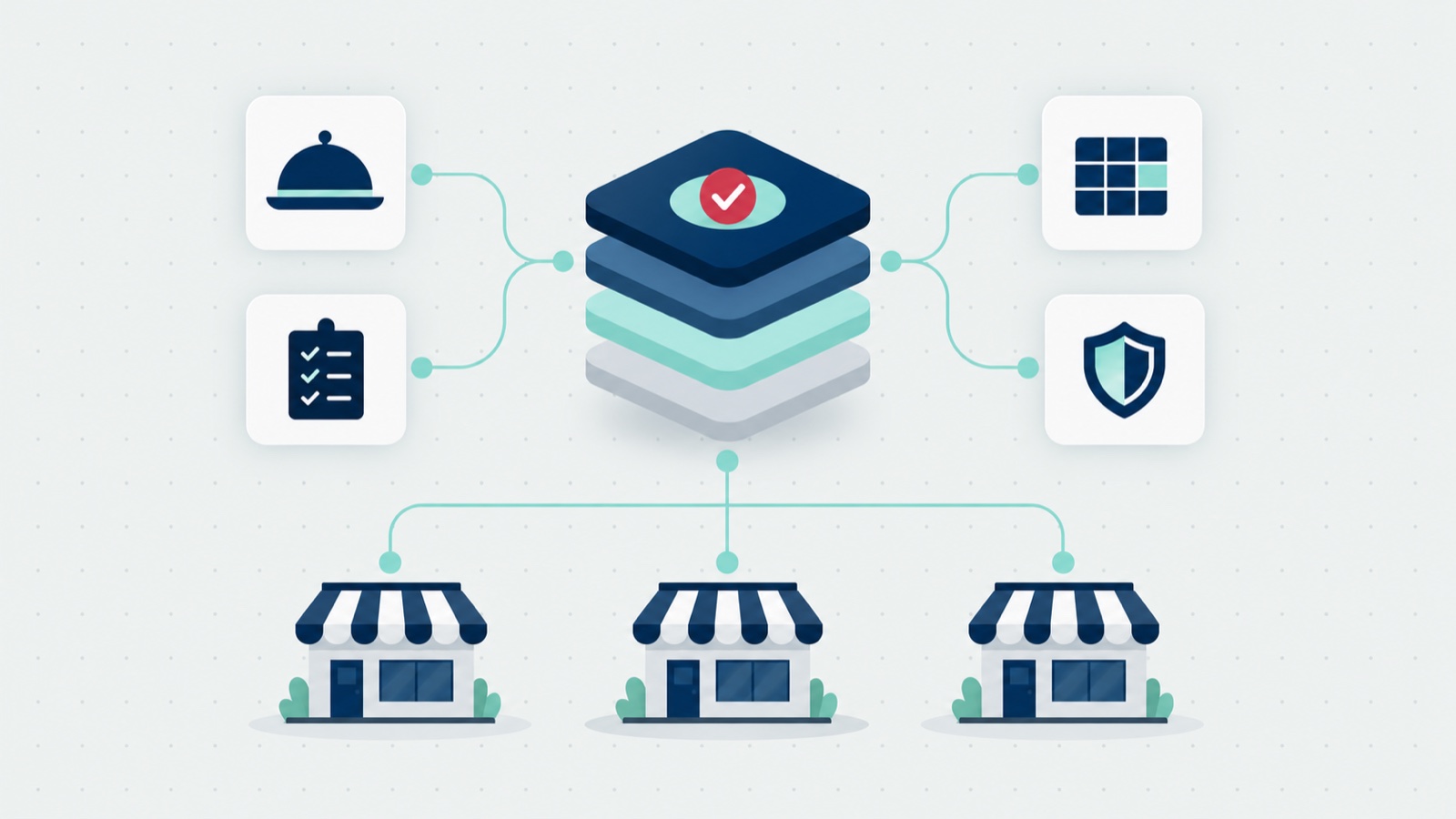

Contract foodservice is the industry behind most of the workplace cafeterias, campus dining halls, and stadium concessions in North America, and it is largely invisible by design: the food wears the client’s building and the operator’s sector brand, not the operator’s corporate name. This post explains how it works, how the contracts are structured, who the players are, where business and industry catering sits in an account, and how technology decisions actually move. It is the industry context behind everything else on this blog, from what a catering management system has to do to how the money reconciles, and The Catering Operations Playbook covers the operational side in full, free, with no sign-up.
TL;DR
- The model: a client company hires an operator to run its food program under a multi-year contract, in one of two main structures, profit and loss or management fee.
- The players: Compass Group, Sodexo, and Aramark by revenue in that order, each running workplace dining through its own brands, with a tier of regional operators below.
- Where catering sits: planned, recurring, department-billed demand, and the part of dining the client’s leaders actually see.
- The status quo is the intake form: most catering programs still run on a form someone reviews and quotes back by hand.
- What is changing in 2026: office attendance is up and peaked on the same days, a tax change is making employers look harder at food subsidies, and RFPs now score catering technology.
- Who decides a platform deal: three roles in parallel, a champion, a blocker, and a buyer, with finance and procurement shaping the deal.
- What outsiders get wrong, starting with the idea that catering ordering is restaurant ordering with bigger portions.
The model: who pays whom
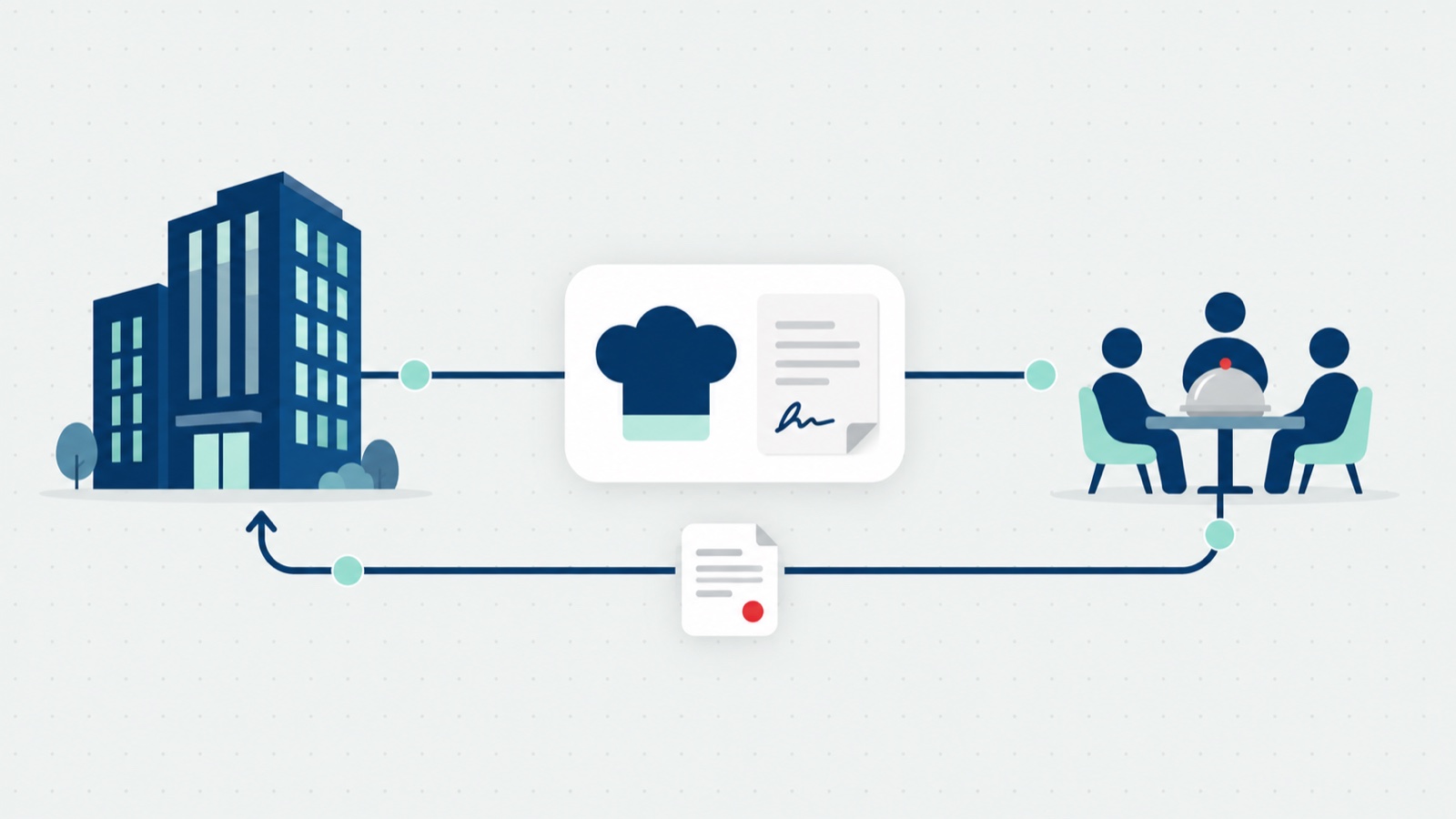
A contract foodservice arrangement has three parties, and following the money explains most of the industry’s behavior.
The client company, the host employer, university, health system, or venue, owns the site and the demand. It hires the operator to run the food program: staffing the kitchens, running the cafeterias and coffee bars, and providing the catering. The client’s people, employees, students, or guests, are the ones actually eating and ordering.
The contracts come in two main families, and Aramark’s annual report for fiscal 2025 defines both in the operator’s own words. On profit and loss: “Under profit and loss contracts, we receive all revenue from, and bear all expenses of, the provision of our services at a client location.” On management fees: “Client interest contracts include management fee contracts, under which our clients reimburse our operating costs and pay us a management fee, which may be calculated as a fixed dollar amount or a percentage of revenue or operating costs.” The same report adds three details worth knowing: a profit and loss contract sometimes pays the client a share of revenue, and some require a minimum guaranteed payment; some management fee contracts pay the operator incentive fees measured by revenue, operating costs, and client satisfaction surveys; and a third kind, the limited profit and loss contract, gives the operator a share of any profit and generally nothing if there are losses. About two thirds of Aramark’s fiscal 2025 revenue came from profit and loss contracts.
The structure changes two things that matter for everything else in this post. Who carries the risk: on a profit and loss account the operator carries the sales risk, and may still owe the client a guaranteed payment; on a management fee account the client carries the operating cost. And who approves a new cost: on a fee account the client pays the operating costs, so a new cost, a catering platform included, usually needs the client’s approval; on a profit and loss account the operator decides within its own budget.
In a business and industry (B&I) account, the money on a catering order flows the way we detailed in the catering accounting deep dive: an employee orders catering for a meeting, billed to their department by cost center or PO number; the operator invoices the client company; the client’s finance team charges the cost back to the department using the code on the invoice.
The players
By revenue, Compass Group is the largest, then Sodexo, then Aramark, which is one of the largest foodservice operators in North America. Reported fiscal 2024 revenues, per Facilities Dive’s reporting of each company’s results: Compass Group $42.2 billion, Sodexo about $24.9 billion, Aramark $17.4 billion. Their footprint is easy to underestimate because the corporate name rarely appears at the counter: each runs workplace dining through its own brands, described on its own site. Compass Group runs workplace dining in the US through several businesses, including Eurest and Restaurant Associates. Aramark runs a Workplace Experience Group, which includes LifeWorks Restaurant Group, “a premium division of Aramark” in its own words. Sodexo runs workplace food brands in the US including The Good Eating Company and Modern Recipe, with order-ahead “in-app or online.”
For scale on the segment this blog cares about: business and industry made up 35% of Compass Group’s North American revenue in fiscal 2024.
One pattern holds across large operators: they standardize. When a platform is an operator’s national standard, changing it at one site is a policy question for the division before it is a product question, which is the landscape we mapped in the CaterTrax alternatives comparison. Catering itself, though, is still run site by site, by the unit’s team, for the host employer on that site.
And the site setups vary more than the operator’s name does. In the accounts we work with, three models recur: the operator runs a kitchen on the client’s site and the catering is made and served there; the operator has space on site but no kitchen, and manages outside caterers for the client, handling orders, logistics, and billing for a management fee; or a commissary kitchen makes catering for several sites, the model we see least. The setup changes what the client experiences and how much back-office work catering takes.
Below the big three sits a tier of regional and mid-size operators, often strongest in one region or one sector.
Where catering sits in a B&I account
Daily dining is the volume; catering is the event-driven layer on top: meeting lunches, executive functions, training days, corporate catering events. Three things make it matter more than its share of revenue suggests.
It is planned demand. A catering order comes with a date, a headcount, and a budget, ordered by a department and billed on account. Cafe sales move with who happens to be in the office that day; catering is committed in advance.
It repeats. The same departments order week after week, so a site that earns the repeat order keeps a steady line of business. The published numbers behind that claim are in how to increase catering sales.
And it is the part of dining the client’s leaders see. Meetings, visitors, and corporate events run on it, which gives catering an outsized voice at renewal.
It is also billed, not paid at a till: departments pay by cost center or PO number on invoice terms, which pulls catering into the client’s finance process and makes the billing code the single most important field on the order.
The status quo is the intake form
Here is the honest picture of where most catering programs stand today: the leading standard in a lot of catering operations is a digital intake form. A buyer fills in a form with their event details, someone on the catering team reviews it, builds the order by hand, and sends back a quote for approval. It is one step up from the phone call, and it tells you something important: catering intake has always needed more information than ordinary ordering, which is exactly why generic tools keep failing at it and why the form persists.
The step past the form is self-serve ordering with the catering questions built into checkout and the rules enforced at the point of order. What that takes, job by job, is the subject of our catering management system guide, and the operational tells that a program has outgrown its form are in five signs your catering intake has hit its ceiling.
What is changing in 2026
Office attendance is up, and it peaks on the same days. Kastle Systems’ Back to Work Barometer reached its highest weekly average since early 2020 in the week of 8 December 2025, at 56.3% across all office buildings, with Tuesday as the peak day. CBRE’s 2026 global occupancy report, a different report with a different method, puts office utilization worldwide at 53%, against 38% in 2024. The operators say the same thing in their results; Sodexo credited part of its fiscal 2024 North American growth to “a continued trickle of consumers returning to the office.” What it means for catering: meetings and team lunches pile onto the days people are in, so kitchen capacity and cutoffs have to plan for those peaks rather than for an average week.
Employers are looking harder at what they subsidize. In the US, for costs paid or incurred after 31 December 2025, employers generally lose the tax deduction both for running an on-premises eating facility and for meals furnished for the employer’s convenience (Internal Revenue Code section 274(o), with narrow exceptions). This is a description of the statute, not tax advice. Expect host employers to scrutinize food program costs more closely and to want spend visible by department, which makes department-coded billing more valuable, not less.
RFPs now score catering technology. Published RFP templates for corporate dining ask operators what technology they use for ordering, payment, and reporting, how often they report, and how they track sustainability (Fooda’s corporate cafeteria RFP guide, January 2026, is one published example, from a company that itself sells workplace dining). And more dining is going to bid: in late 2024, Aramark pointed to first-time outsourcing in its pipeline of new business. In the RFPs we see, the operator’s catering technology is now a scored part of the bid. Accounts are still won on the cost and quality of running the food program, and that cuts the same way: an operation that runs catering by hand has less room on price. For operators writing the technology section of a bid, we publish an RFP technology checklist.
The client’s systems set the technology requirements. The requirements that come up most in the deals we see: billing by cost center or PO with invoices that map to the client’s accounts, single sign-on against the client’s own directory, card data tokenized with the platform PCI DSS Level 1 and its payment providers PCI certified, and separate site, corporate, and supervisor access. Meeting a client’s proprietary systems where they are is precisely the job of App8’s enablement team.
Who decides a platform deal
Three roles decide, and they are worked in parallel, not one after another:
| The role | Who it usually is | What they need to see |
|---|---|---|
| The site operator, who champions it | The general manager, district manager, or catering manager at the client site | Intake that stops arriving by phone, email, and PDF, and production that follows the order |
| The technology lead, who can block it but does not buy it | A VP digital or director of innovation at the division | Integration with the systems already in place, single sign-on, and the security answers |
| Operational leadership, who buys it | The division vice president or president who owns the profit and loss for the B&I business | One setup deployed across every site, and the program’s results |
Finance and procurement shape the deal alongside them: finance wants catering receivables that post into the ERP with the right codes, and procurement wants the contract structure, insurance, and vendor-risk answers ready. And the contract structure reaches into the deal itself: on a management fee account the host employer pays the cost, so the client often approves as well.
Three disqualifiers worth knowing, because titles mislead: a champion with no operating responsibility is not the site operator; a procurement contact with no platform authority is not the technology lead; a leader who owns no profit and loss or program budget is not the buyer.
What outsiders and software vendors get wrong
- Catering runs by its own rules. Vendors often build it like a restaurant’s online ordering. A catering order needs advance notice and cutoffs, changes right up to the moment it is fulfilled, one-step reorders, allergens that reach the kitchen, production sheets for large volumes, and billing to departments on payment terms. On the surface it looks like any ordering experience; behind it, the dynamics are different.
- Operators need to run it themselves. A tool that sends a simple menu change to the vendor’s support desk slows everything down. Self-service is hard to build with this much functionality, and it is what lets an operator keep control and speed.
- A quote request is the wrong tool for a standard order. Inquiry forms have their place, for corporate catering events. For a standard order, every round of email or phone adds coordination, delay, and missed items.
- The operator has two customers. The client company holds the contract, and its employees order and eat. A pitch built only around the diner misses who renews.
- The account is won on the food program. The operator wins or loses a client on the cost and quality of dining, and technology is part of its bid. A platform can be the right choice and still lose when the operator loses the bid, which is a useful dose of humility for anyone selling software into this industry, us included.
Reading further
The catering scorecard places a program on the five-stage maturity model in 90 seconds. The Catering Operations Playbook carries the four jobs a catering operation runs on, free, with no sign-up. And the case studies carry the published, attributed numbers behind everything this blog claims.
Frequently asked questions
What is contract foodservice?
Contract foodservice is the industry where a company, a school, a hospital, or a venue hires a specialist operator to run its food program instead of running it in-house. The client provides the site and the demand; the operator brings the culinary teams, the processes, and increasingly the technology, and runs the cafeterias, coffee bars, and catering inside the account under a multi-year contract.
How are contract foodservice contracts structured?
Two main families. Under profit and loss contracts, the operator receives the revenue and bears the expenses of the operation, and sometimes pays the client a share of revenue or a minimum guaranteed payment. Under management fee contracts, the client reimburses the operator's operating costs and pays a fee, fixed or calculated as a percentage of revenue or costs, sometimes with incentive fees tied to revenue, costs, and satisfaction surveys. Aramark's fiscal 2025 annual report defines both, and reported about two thirds of its revenue from profit and loss contracts.
What does B&I mean in foodservice?
B&I stands for business and industry, the segment of contract foodservice that serves corporate workplaces: office cafeterias, coffee bars, and the catering for meetings and events inside those buildings. The host employer pays for the program and its employees and departments place the orders. For scale, business and industry made up 35% of Compass Group's North American revenue in fiscal 2024.
Who are the largest contract foodservice companies?
By revenue, Compass Group is the largest, then Sodexo, then Aramark, which is one of the largest foodservice operators in North America; reported fiscal 2024 revenues were about $42.2 billion, $24.9 billion, and $17.4 billion respectively. Each runs workplace dining through its own brands: Compass Group through businesses including Eurest and Restaurant Associates, Aramark through its Workplace Experience Group including LifeWorks Restaurant Group, and Sodexo through brands including The Good Eating Company and Modern Recipe. Below them sits a tier of regional and mid-size operators, often strongest in one region or sector.
Where does catering fit in a contract foodservice account?
Catering is the event-driven layer of a business and industry account: the meeting lunches, executive functions, and corporate catering events that employees order on top of daily dining. It is planned demand, ordered with a date, a headcount, and a budget, billed to departments by cost center or PO number, and it recurs weekly, which makes it one of the account's clearest growth levers and the part of dining the client's leaders see most.