
How to increase catering sales is a question with a thousand generic answers, and if you run catering inside a corporate dining account, most of them were written for a wedding caterer. This post is built differently: it is two real programs with published numbers, a corporate cafe whose catering orders rose 513% in twelve months and a ballpark whose suite catering sales are now 153% above where they started, and the mechanisms behind each, stated plainly enough to copy. The operational foundation those mechanisms sit on is covered in our guide to what a catering management system actually needs to do, and The Catering Operations Playbook carries the full worksheet, free, with no sign-up.
TL;DR
- Two results, stated honestly: +513% orders at one corporate cafe (workplace catering, single site), and suite catering sales at a named ballpark now +153% on 2023 (a venue result). Sources and attributions in full.
- Buyers reorder for two reasons: the last order went right, and the next one takes less effort than finding someone new.
- Seven levers, in order of leverage, from publishing prices to following up after every single order.
- The mistakes that lose the order first: seven common ones, most fixable without software.
- Two things that did not work, from our own experience.
- The growth compounds: the cafe’s latest 12 months are 46% above its first year online, and the climb barely pauses.
- Proving it at renewal: report the client’s own numbers all year, so renewal confirms what they have already seen.
Two results, stated honestly
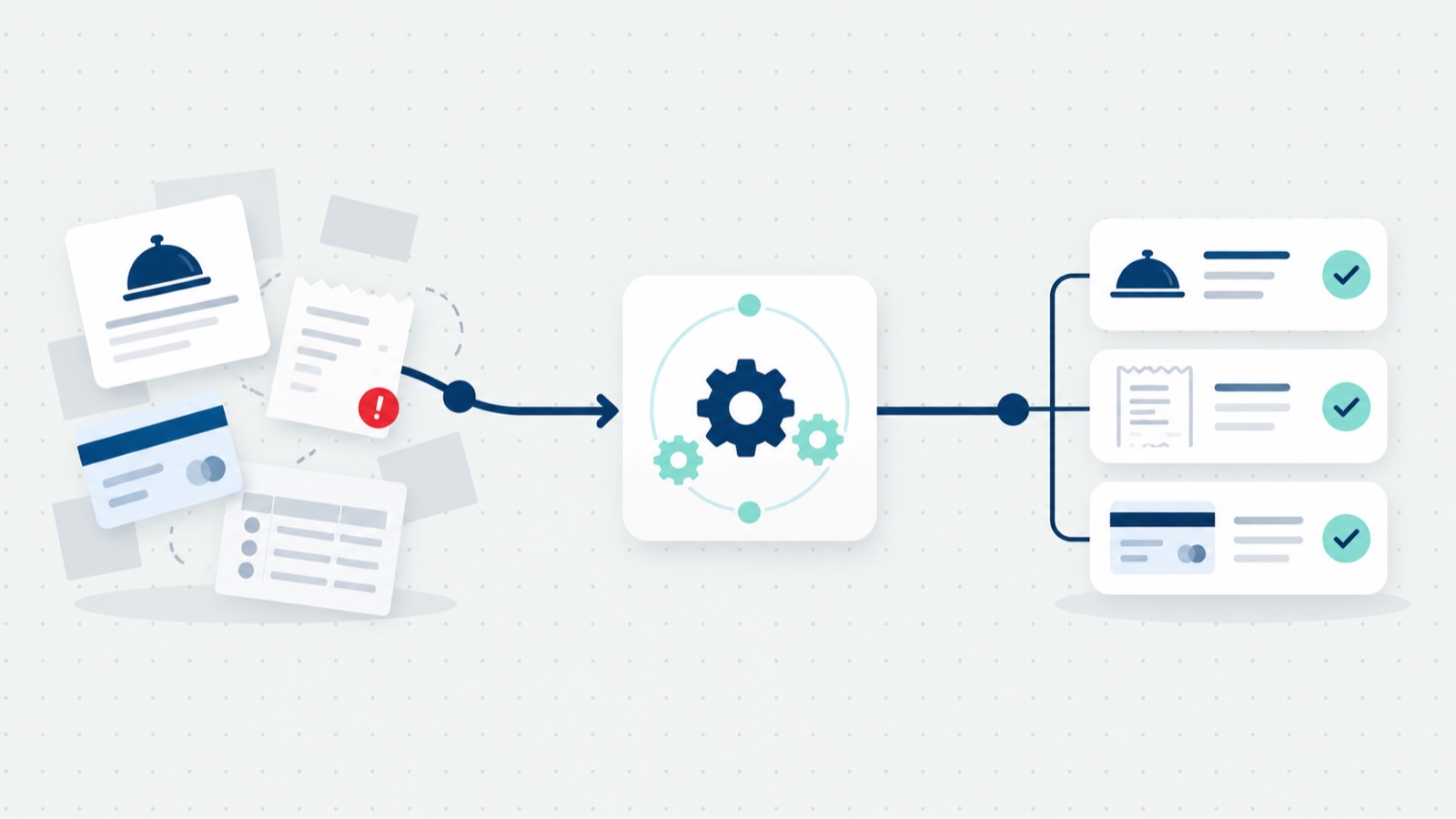
The corporate cafe. A workplace cafe run by one of North America’s largest foodservice operators replaced a PDF-and-phone process with Rally Catering. Catering orders rose 513% and revenue 526%, 70% of orders were repeat orders, multi-order buyers grew 46%, and 67 hours of manual intake work went away. Results reported by the operator for one enterprise workplace site, anonymized and single-site, over the 12 months to January 2026 against the year before. Repeat orders are orders placed by returning buyers. The manual work is an estimate of about five minutes an order across the orders in the period. The full account is in the enterprise workplace catering case study.
The ballpark. The Ottawa Titans moved suite catering from phone and email to pre-ordering from a branded menu. Suite catering sales rose 93% from the 2023 season to 2024, the published result in the Ottawa Titans case study, and the climb has continued: the 2025 season finished 73% above 2023, and the 2026 season, to 24 September, is 153% above. Their food and beverage supervisor, Michael D’Agostino: “The pre-order piece is huge for us in the suites. It’s guaranteed sales, and it helps us manage inventory.” This is a venue result, suite catering at a ballpark, not a workplace catering number.
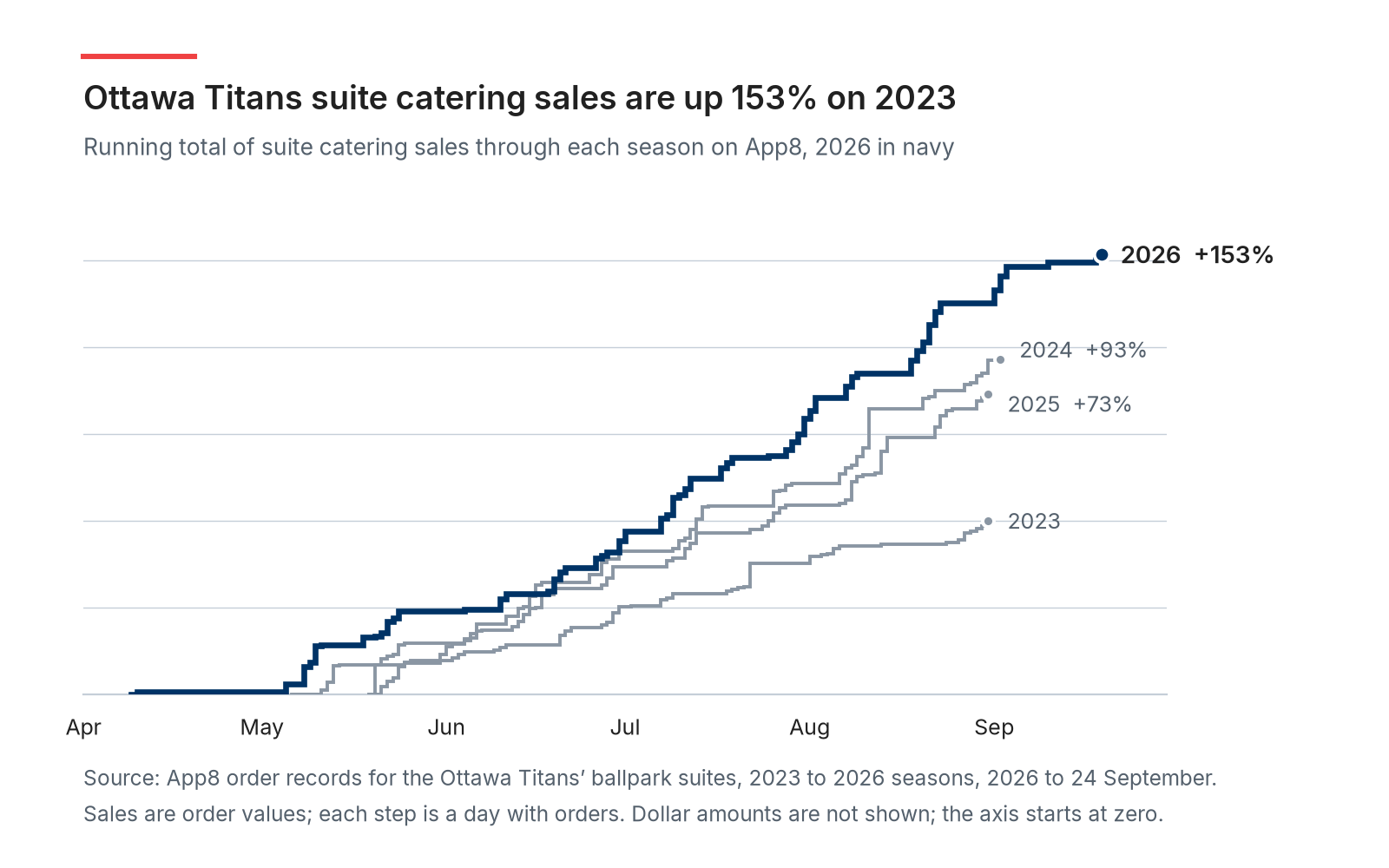
One site and one venue are not a fleet average, and we present them as what they are. But the two programs grew the same way, which is the point of this post.
What makes a corporate buyer reorder
A corporate buyer reorders when the last order went right and the next one takes less effort than finding someone new. Everything else hangs off those two conditions.
- The last order went right. The count, the food, the time, and the invoice were all correct. The buyer is ordering for a room of colleagues on a department budget, so one visible miss sends them to another caterer. Food quality and service matter enormously here, and they are not the whole picture: a consistent, good standard plus a frictionless way to order beats occasional brilliance behind a phone line.
- The next order takes one step. The buyer’s account, preferences, and payment are saved, and a past order refills the cart in one action.
- The link is where the buyer already looks. An email signature, a QR code in the building, the client company’s intranet.
- The bill looks after itself. The order carries the department’s cost center or PO number, and the invoice goes to the client’s finance team. The person who ordered never has to chase it. And because prices show up front, the buyer can get their own internal sign-off before placing the order, instead of shuttling quotes back and forth by email.
- Someone follows up, every time. A thank-you after each order, and a set date to ask about the next one.
The assistants, office managers, and team leads who place these orders are ordering for 10, 20, 50 people between two other tasks. What they want is simple: allergens and preferences that actually reach the kitchen, an order placed without back-and-forth, food that is as good as last time, and an invoice their finance process accepts without them printing anything.
Seven levers, in order of leverage
- Publish prices for standard orders. A menu behind a quote request sells nothing on its own, and some buyers go where they can see prices first; you never see the order you lost. Keep quotes for work that genuinely needs one.
- Make the first order feel like ordering, not registering. The account gets created in the checkout flow, not as a gate in front of the menu. Every field a buyer fills before seeing food is a reason to order from somewhere else.
- Make the second order one click. Saved account, saved preferences, order history, and a reorder button. At the cafe, 70% of orders were repeat orders; the reorder path is where the compounding lives.
- Put the link where the buyers already are. The cafe team put the ordering link in email signatures, on QR codes, and on building signage, so reordering was always one tap away. Distribution is not a technology feature, and it moved the number anyway.
- Let departments pay the way finance requires. Corporate buyers order more when they can bill properly: invoice on terms, PO and cost center captured and checked at the order. A buyer who cannot expense the order is a buyer who orders once. The billing mechanics are covered in the catering accounting deep dive.
- Turn corporate catering events into committed pre-orders. The Titans’ whole result is this lever: orders placed in advance are guaranteed sales and a kitchen that preps to real demand rather than a guess.
- Follow up after every order, every time. A thank-you note after each fulfilled order, one personal detail if you can, and a date set to ask about the next event. Not most of the time: every time, as an automatic step in the process. This is a practice, not a software feature, and it is where the hours that digital intake gives back should go. The cafe team kept making follow-up calls with the time online ordering freed; the technology takes the keying, the team does the selling.
The mistakes that lose the order first
Most catering sales are lost before anyone tastes the food. The most common mistakes, what they cost, and the fix:
| The mistake | What it costs | The fix |
|---|---|---|
| Standard orders go through a quote request | Some clients go where they can see prices first, and you never see the order you lost | Publish prices for standard orders; keep quotes for work that needs one |
| The menu is hard to use: buried a few clicks deep, no price for a headcount, no lead times | The buyer is ordering between two other tasks and moves to a caterer they can finish with in one sitting | Put the menu one click from the home page, show the price for a headcount and the lead times, and take the order online |
| Not knowing the client’s buyer and how they pay | Corporate clients buy through a named buyer, against a budget, with a PO or cost center; without that, every order turns into back-and-forth | Set each client account up once: who orders, the code they bill to, who receives the invoice |
| The rules live in one person’s head | Everybody calls one person to ask whether an order can still go in; when that person is away, the answer changes | Write down the cutoffs, minimums, and lead times, and let the ordering system hold them |
| A change never reaches the kitchen | The order arrives wrong, and the buyer remembers it | Every change updates the order itself, and the production sheet follows it |
| The sales team spends its day taking orders | Hours go to quoting and keying standard orders, not to the relationships, repeat clients, RFPs, and larger events that grow sales | Let standard orders come in online; know your revenue, order count, and team effort by type of order |
| Corporate event inquiries sit in an inbox waiting for a quote | The client books whoever answers first | Take corporate event inquiries through a form, and send a quote the client can approve online |
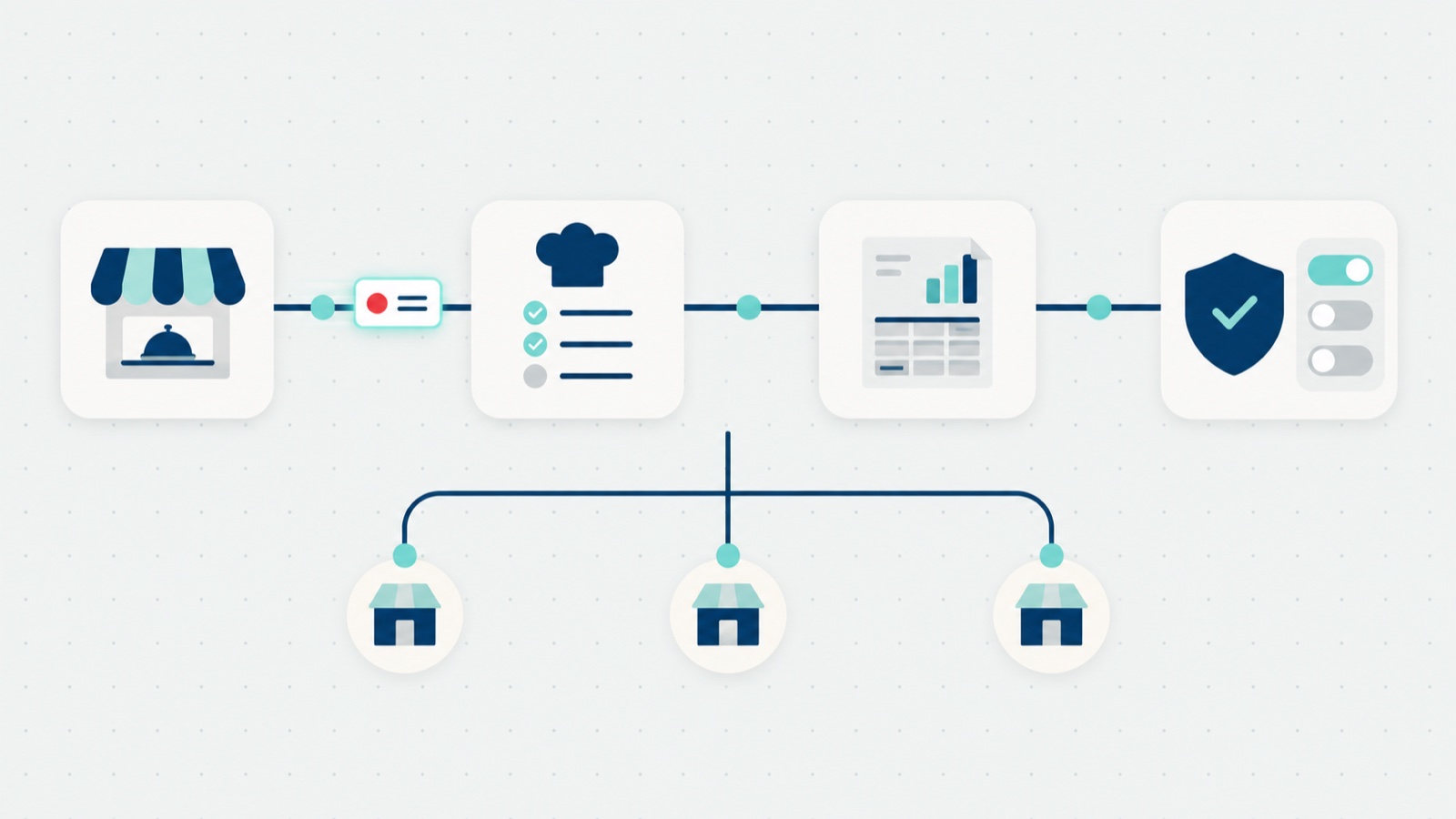
The first four rows come straight from The Catering Operations Playbook, free with no sign-up, and the intake side is covered in depth in five signs your catering intake has hit its ceiling. On the last row: in Rally Catering, corporate catering events run in the same system as everyday catering, an inquiry form, a quote the client approves or secures with a deposit, and a banquet event order (BEO) for the kitchen.
That sixth row deserves a sentence more. Ask a catering sales organization what its salespeople do, and the honest answer is often: wait for the phone, monitor an inbox, build quotes, key them in. That is order taking. Salespeople grow sales by building relationships, winning repeat clients, and pursuing RFPs and larger events, and they can only do that with the hours that standard orders stop consuming.
Two things that did not work
Honesty section, from our own experience:
The “we now cater” banner, alone. A pull-up banner in the storefront tells walk-in customers you cater, and that visibility is genuinely worth having. But a banner with only a phone number on it asks a lunch customer to become a catering buyer at the exact moment they are not planning an event. Awareness without a convenient way to act on it, later, when the need arrives, falls flat. Do the banner; never let it be the whole plan.
The platform switched on, and nothing else changed. We sell catering ordering technology, so take this one seriously: buying a first-party ordering platform and doing nothing else does not raise sales. If the team does not put the link in front of buyers, if the operation does not move its rules into the system, if customers are never shown where to order, the menu just sits there. An operation runs on people, process, and technology; invest in only the third and it will not do the thing you bought it for.
The growth compounds
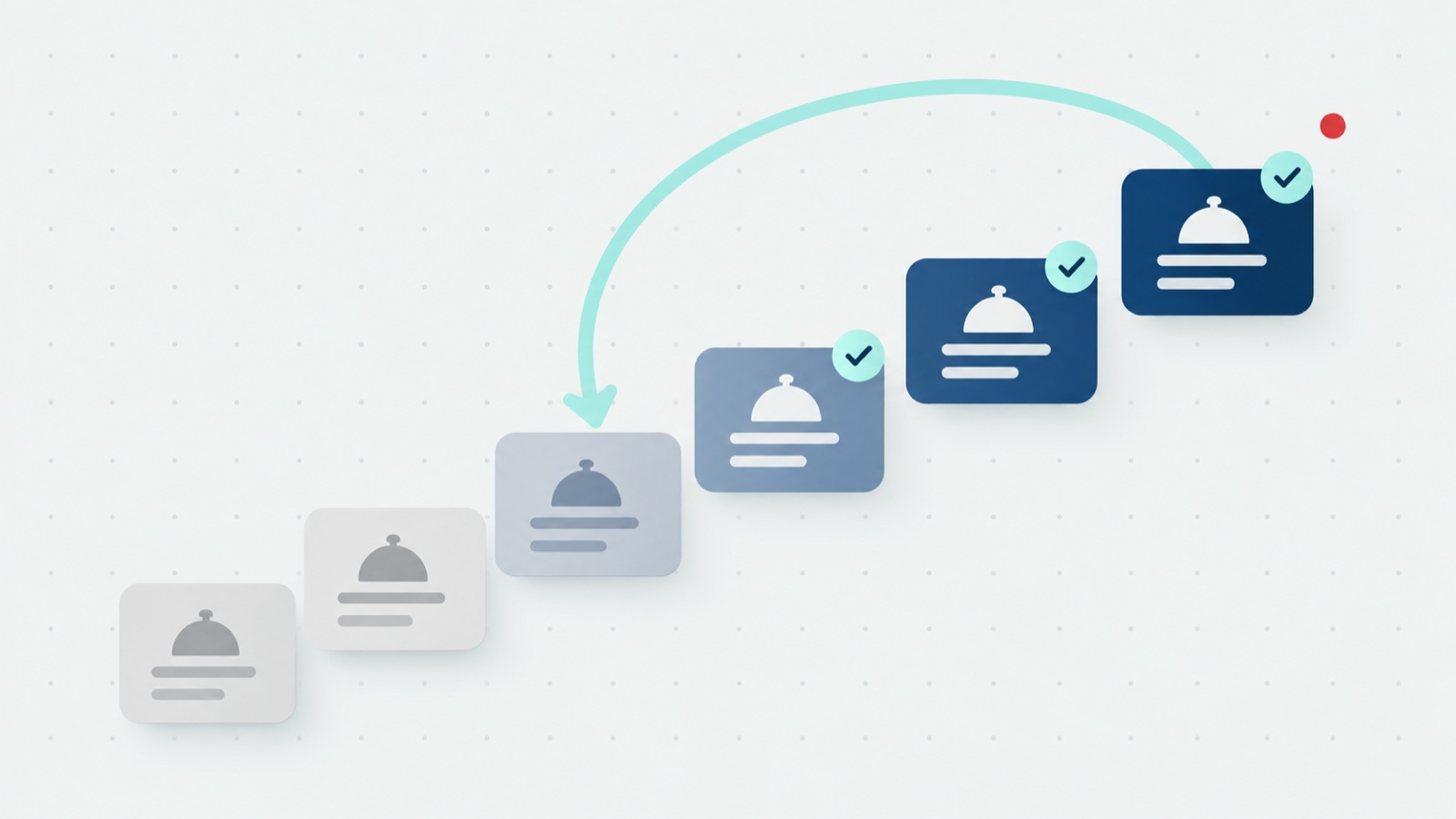
The cafe’s growth curve is worth reading closely. Inside the published year, momentum accelerated: orders rose a further 33% in the second half. And the climb continued after the first year. Over its latest 12 months, to 24 September 2026, the same site’s catering sales are 46% above its first 12 months online, and its orders are 37% above, from App8’s order records. To be precise, because the case study also carries a 46%: this figure measures the site’s catering sales across two periods; the case study’s 46% measures growth in multi-order buyers inside the first year. Different measures, same story.
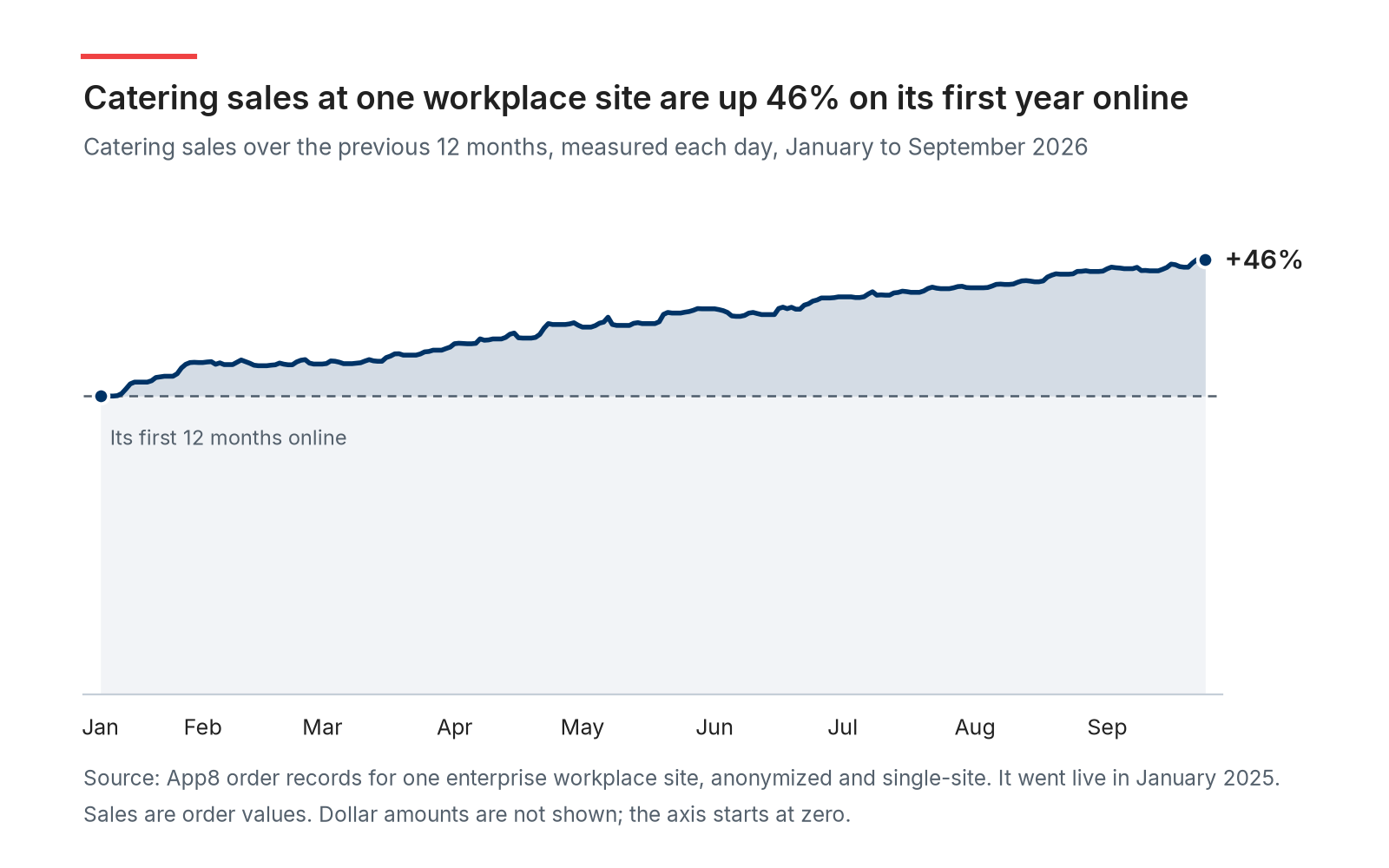
That is what happens when accounts, order history, and reorder buttons accumulate: every month of operation makes the next order easier for more buyers. A program that treats each order like the first one starts from zero every morning. A program built for the returning buyer compounds.
Proving it to the host employer at renewal
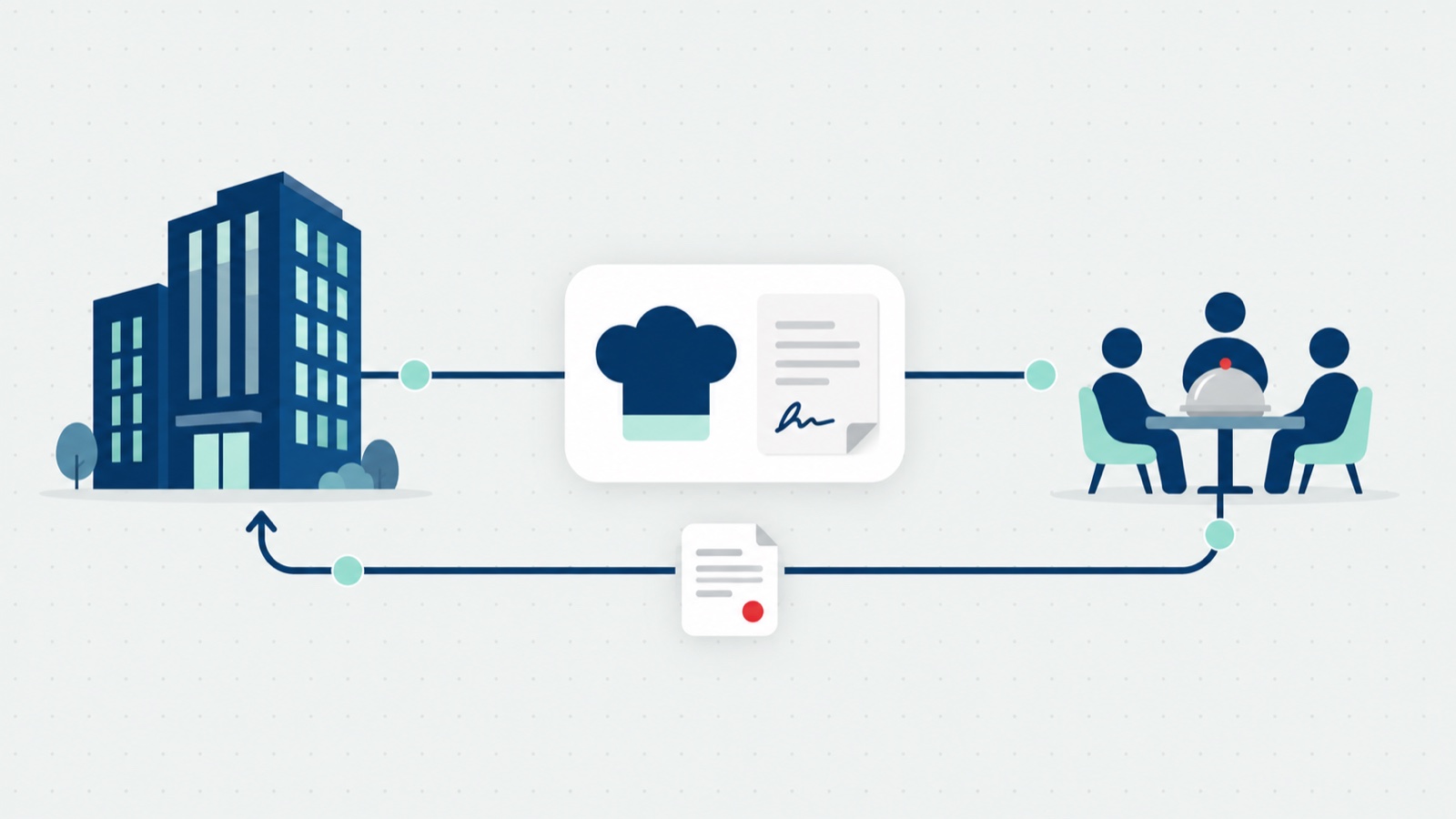
Report the client’s own numbers all year, so renewal confirms what the client has already seen. The client company pays for catering through its departments and judges the program by what its people see: orders that arrive right and on time, bills that carry the right code, and spend it can see by department. On some management fee contracts, money rides on those numbers directly, through incentive fees measured on revenue, costs, and satisfaction; the contract structures are covered in our contract foodservice explainer.
The numbers to bring:
| The number | Why the client cares |
|---|---|
| Catering orders and spend, by department or cost center, by month | Shows which parts of the business use the program, and whether use is growing |
| The share of orders from returning buyers | Repeat use is the client’s own people choosing the program again |
| Orders delivered on time and correct, and what happened with the misses | This is what a client remembers at renewal |
| Invoices that carried the right code the first time, and the corrections | The client’s finance team charges each department back using that code; processing a single invoice costs the average accounts payable team about $9.40 (Ardent Partners, State of ePayables 2024, a vendor-sponsored report) |
| One change made this period, and its result | Shows the operator improving the program, not only running it |
How we would run it as the operator: agree the numbers and record the baseline at the start of the contract; report quarterly on one page, in the client’s words, straight from the ordering record, never rebuilt by hand; measure each change before it, at day 14, and at day 90, the method in the Playbook’s priority check; and at renewal, walk through the trend the client has already seen each quarter. App8’s reporting covers revenue, volume, customer mix, item performance, and program participation, and the finance side, revenue, cash, and receivables, is the subject of the catering accounting post.
Where to start
Score your own program first: the catering scorecard places it on the five-stage maturity model in 90 seconds, and the intake stage is where most of the seven levers live. The Catering Operations Playbook carries the moves in full, free, with no sign-up. And if you want to see the reorder path, the visible menu, and department billing running in one program, talk to us.
Frequently asked questions
How do you increase catering sales in a corporate dining account?
Remove the reasons people do not order. Put the menu one click away with photos and prices, make the first order feel like ordering rather than registering, make reordering one click, put the ordering link in email signatures, on QR codes, and on building signage, let departments bill by cost center or PO number, and follow up after every order, every time. At one corporate cafe that ran this way, orders rose 513% in twelve months and seven in ten orders came from returning buyers.
What makes corporate catering buyers reorder?
A corporate buyer reorders when the last order went right and the next one takes less effort than finding someone new. The last order went right means the count, the food, the time, and the invoice were all correct; one visible miss in front of a room of colleagues sends the buyer elsewhere. The next order takes one step means the buyer's account, preferences, and payment are saved, and a past order refills the cart in one action.
Does pre-ordering increase catering revenue?
At the Ottawa Titans ballpark it did: moving suite catering from phone and email to pre-ordering from a branded menu grew suite catering sales 93% from the 2023 season to 2024, and the 2026 season, to 24 September, is 153% above 2023, from App8's order records. That is a venue result rather than a workplace catering number, but the mechanism, committed orders in advance that the kitchen can prep against, applies to any catering operation with events.
How long does it take to grow catering sales this way?
The published corporate cafe result is a twelve-month window: order volume up 513% year over year, with orders up a further 33% in the second half of that year. And the growth continued past the first year: over its latest 12 months, to 24 September 2026, the same site's catering sales are 46% above its first 12 months online, and its orders are 37% above. The gains compound as buyer accounts, saved preferences, and reorder history build up.