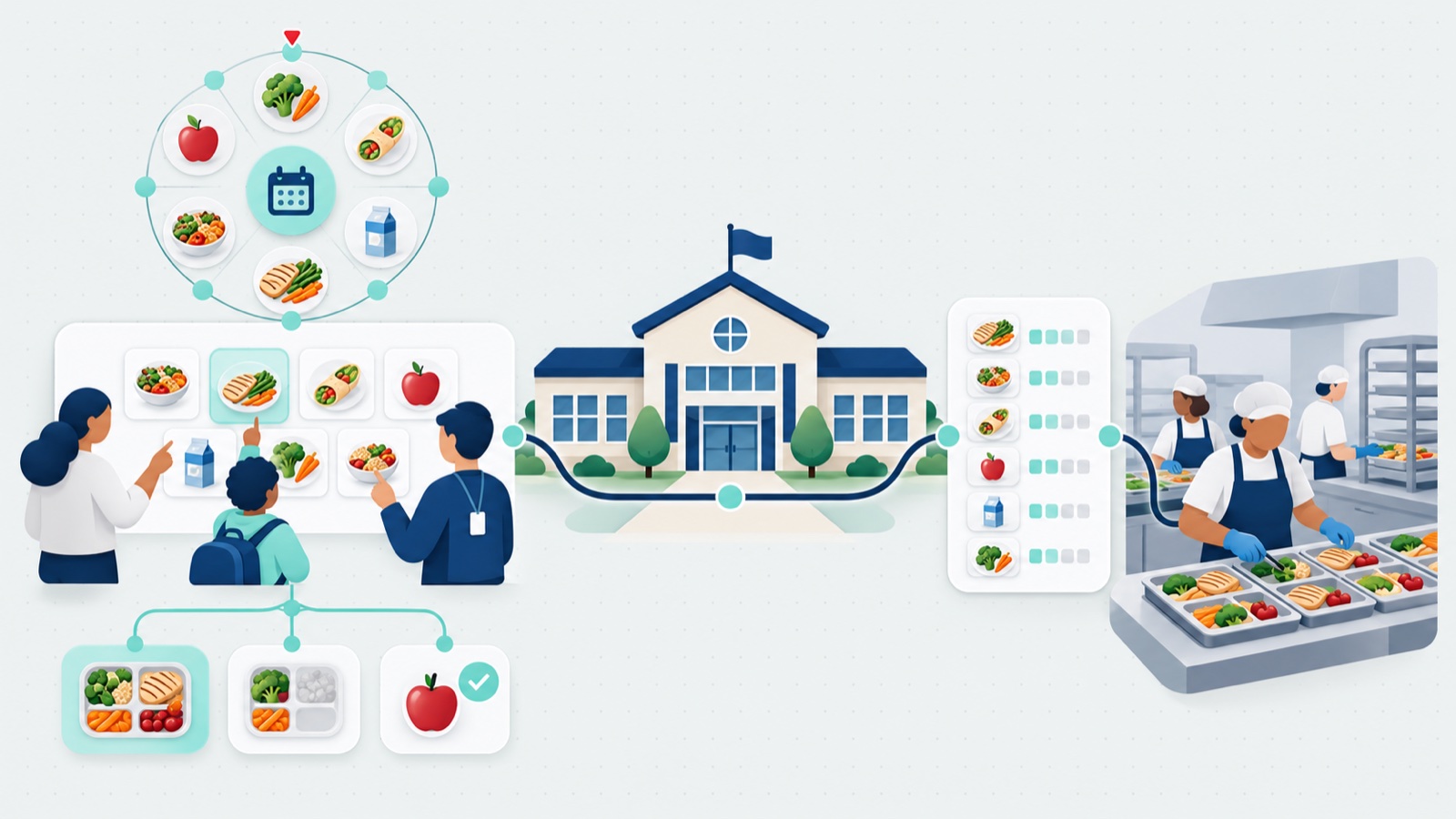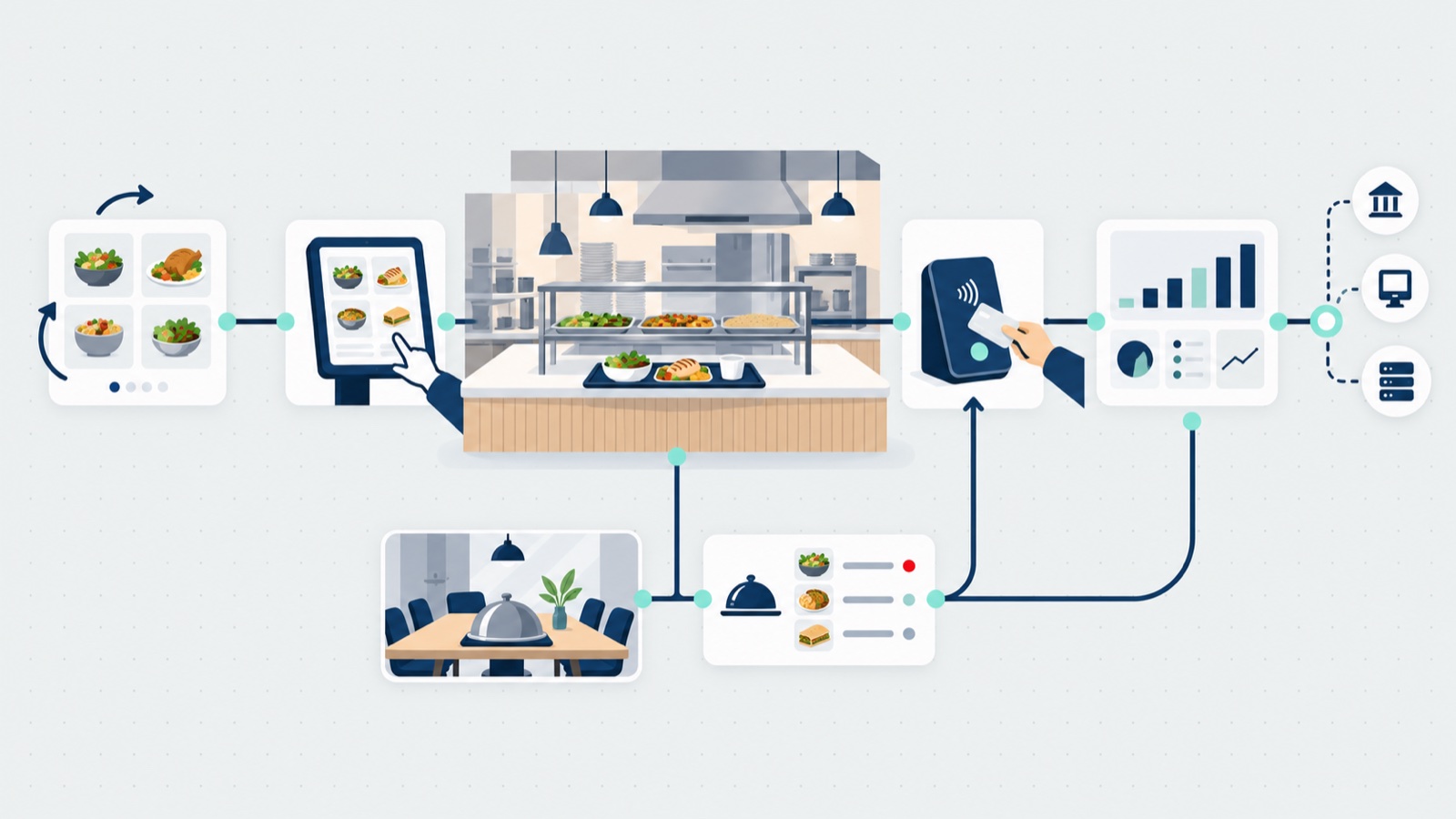

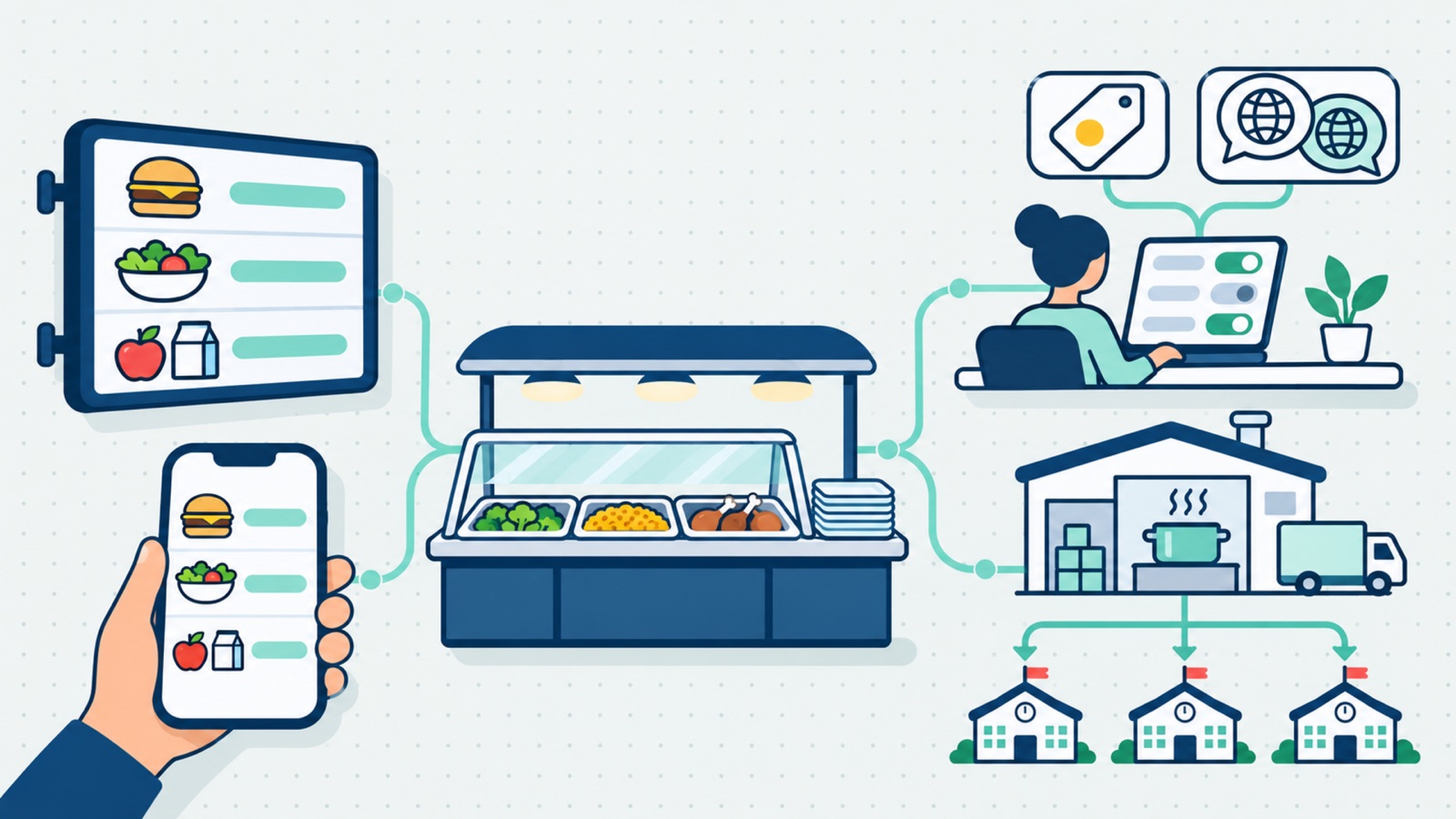
Nutrislice alternatives are worth mapping carefully, because Nutrislice comes up in most school foodservice conversations: its own pages cite 25,000+ schools and over 30,000 locations. In App8’s view it’s also the product we meet most often in school deals, usually compared on K-12 pre-ordering. This guide follows the same rules as our other alternatives guides: what Nutrislice does well stated from its own pages (as of November 2026), who should stay on it, the field mapped to the program each product fits, and what Rally Schools does that Nutrislice’s pages don’t describe, never claiming what it can’t do.
TL;DR
- What Nutrislice is: menus, signage, labels and ordering in one platform, across K-12, campus, healthcare and workplace dining.
- Where it fits and where to ask harder: the menu side is its center; subsidies, parent accounts, French and the operator’s side of many schools are demo questions.
- The 6 best alternatives, by use case: district nutrition systems, menu and ordering tools, and hot lunch programs do different jobs, each with pros, cons and published pricing.
- Who should stay, and what Rally Schools does that Nutrislice’s pages don’t describe, subsidies and French included.
- Switching: App8 has replaced Nutrislice for a school foodservice operator, and menus import from CSV instead of being retyped.
The short version:
| Best for | Our pick |
|---|---|
| Menus, nutrition info, signage and labels | Nutrislice |
| Meal accounts, school fees, applications and eligibility (US districts) | LINQ’s family portal or MySchoolBucks |
| Menus and ordering with an outside food partner | Boonli |
| Parent-council hot lunch days, mostly in Canada | MunchaLunch or Healthy Hunger |
| Paid and subsidized meals across many schools, run by an operator | App8’s Rally Schools |
What Nutrislice is, in its own words
Nutrislice calls itself “Digital menus, signage, food labels, and ordering all in one, streamlined platform for foodservice.” It serves corporate dining, higher education, K-12 and healthcare, was founded in 2011 by Brian Crapo, Mike Craig, and Ben Roberts, and describes itself as “empowering over 30,000 locations around the world.”
Its K-12 page leads with “A modern digital menus experience for today’s busy schools” and offers online menus, digital signage, mobile ordering, and digital labels. The page cites 25,000+ schools and says it integrates with K12 systems, “transforming data into ADA compliant menus for your guests.”
Its ordering page lists multi-day pre-ordering, pickup windows, throttling orders at peak times, meal customization, pickup or delivery, and “diverse payment options”, naming no payment provider. We found no price list on its pages.
Where Nutrislice fits well, and what to ask in a demo
In App8’s view, read from its pages, Nutrislice centers on the menu: what students and families see, and how it reaches signage and labels. That focus is real strength in three situations.
- Menus, nutrition and labels. Its pages center on digital menus, signage and food labels, and its K-12 page says it turns district data into ADA compliant menus.
- Districts already running a district nutrition system. Its K-12 page says it integrates with “K12 systems” without saying which. A district with its own point of sale and eligibility system may add Nutrislice for menus and ordering.
- One menu tool across many kinds of dining. It serves schools, campuses, hospitals and workplaces from one platform.
An operator running paid and subsidized meals across many schools needs a lot on the operator’s side, and that’s what to ask about in a demo. Its pages don’t describe the following, so ask, rather than assuming either way.
- Operator-configured subsidies. Its K-12 and ordering pages don’t mention subsidies, its K-12 page doesn’t mention meal accounts, and its ordering page names “diverse payment options” without saying which.
- Parent accounts. Its K-12 page names parents as an audience for menus. It doesn’t describe accounts where a parent orders for each child.
- French. Its app listing says menus can be browsed “in 50+ languages.” Its pages don’t name French or describe French on the operator’s side.
- The operator’s side of many schools. Its ordering page lists an order queue and order and item-count reports. Its pages don’t describe production and order reports by school, class and student, actions in bulk, or one kitchen serving several schools.
The 6 best Nutrislice alternatives, by use case
School meal software falls into three groups, and the fastest way to a bad purchase is comparing across them. The entries below are numbered for reading order, not ranked: each product is described from its own pages, as of November 2026, and the right pick depends on the program you run.
1. Rally Schools, best for operator-run paid and subsidized meals
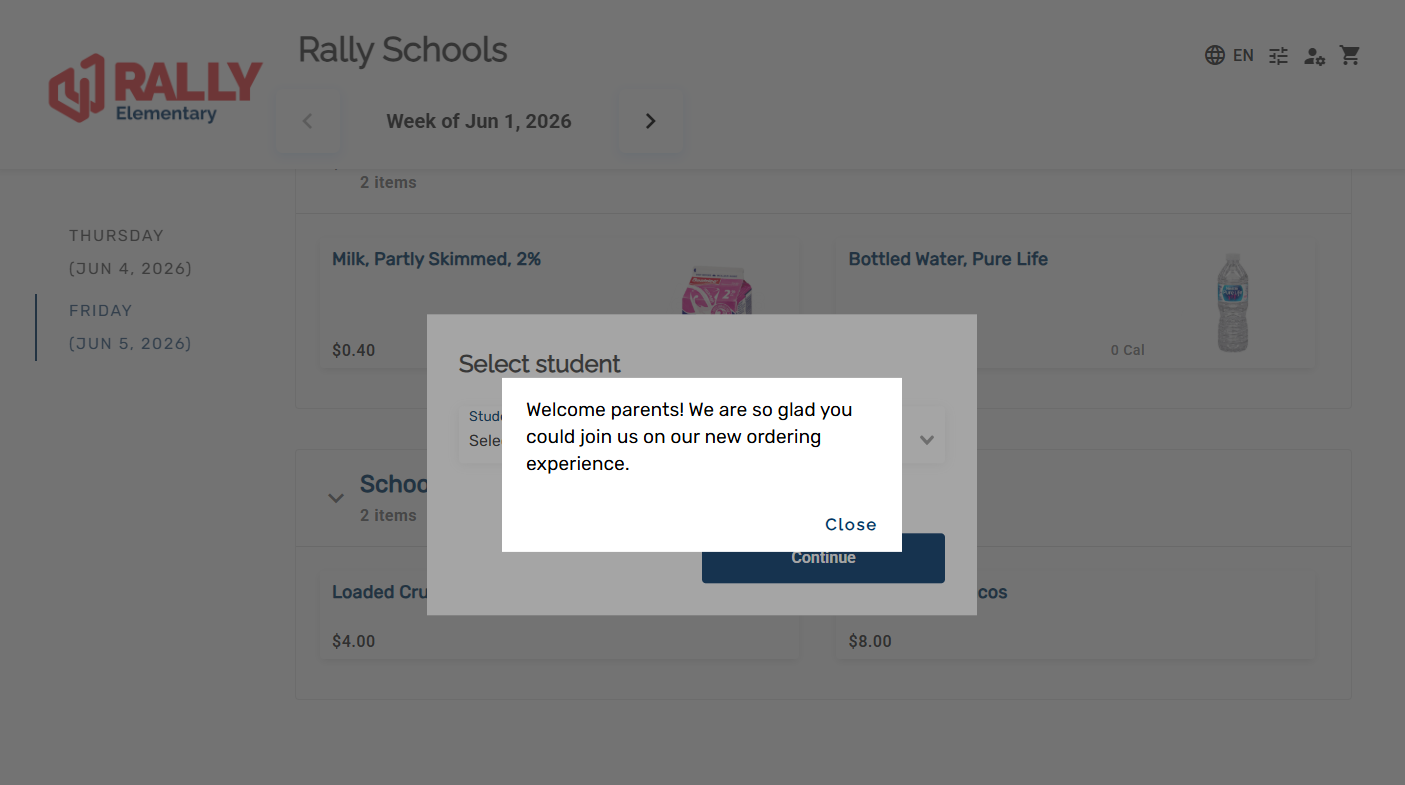
Rally Schools is App8’s school meal platform, built for the operator cooking for many schools, often from one commissary kitchen. Parents order from a calendar for each child, the operator runs subsidies, production and bulk actions, and the whole thing works in English and French on both sides.
If you’re the operator this guide is written for, this is the entry built for your job end to end, and the rest of the list is context. The full walkthrough, demo screens included, is later in this post.
Pros
- Operator-configured subsidies, with every order reporting as subsidized or paid
- Parent accounts with a profile per child: name, class, grade, teacher, allergens
- English and French on family menus and the operator's side, written for Quebec's Bill 96
- Production and order reports by school, class and student, with bulk actions
- Canceled orders can become credits families spend later, instead of refunds
- Flexible pricing: a subscription scoped to your program, not per-seat tiers
Cons
- Built for foodservice operators, not volunteer parent councils
- App8 does not determine eligibility or manage federal reimbursement
- No digital signage or food-label printing, which is Nutrislice's center
Pricing: flexible by design. The subscription is scoped to your program rather than published as tiers, because a three-school program and a thirty-school program are different jobs, and the place to get your number is a demo.
2. LINQ Connect, best for US districts that want accounts, fees and applications in one portal
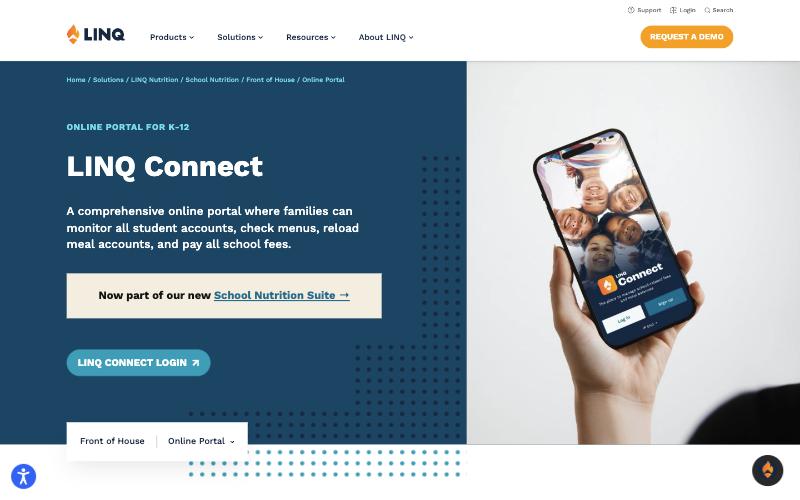
LINQ’s family portal page describes “a comprehensive online portal where families can monitor all student accounts, check menus, reload meal accounts, and pay all school fees,” where families can also “submit and update meal applications.” That’s the district nutrition job in one sentence: meal accounts, school fees and eligibility paperwork in one system.
Pros
- Student accounts, menus, meal accounts and school fees in one family portal, per its page
- Families can submit and update meal applications online
- Part of a wider district nutrition suite with the point of sale behind it
Cons
- Built around US district structures and programs
- Its pages don't describe operator-configured subsidies or an operator's commissary production
- Its pages don't describe French
- No public price list
Pricing: no price list on its pages as of November 2026; it sells to districts through a demo.
3. MySchoolBucks, best for paying school fees from one app
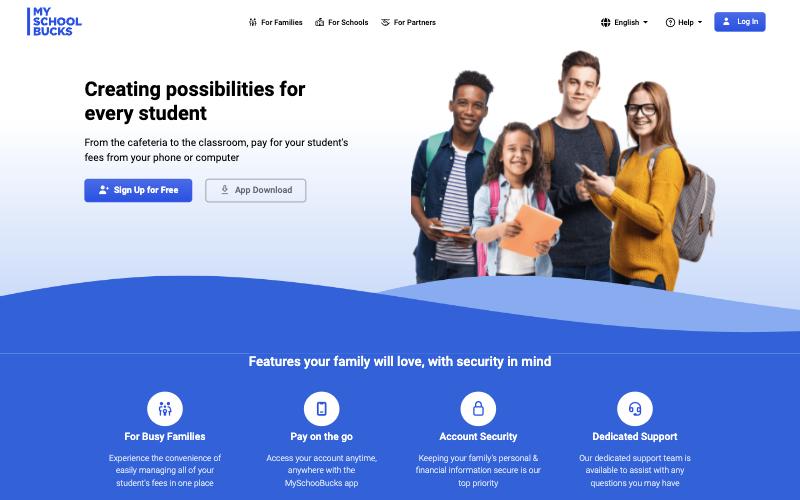
MySchoolBucks leads with “From the cafeteria to the classroom, pay for your student’s fees from your phone or computer.” It’s the payment layer many US districts put in front of families, and its site runs in English, Spanish, Arabic and Vietnamese.
Pros
- Cafeteria balances and school fees paid in one place, on web and mobile
- Site and app offered in English, Spanish, Arabic and Vietnamese
- Familiar to US families whose districts already run it
Cons
- A payments product, not an ordering back office for an operator
- Its pages don't describe pre-ordered meals by class and teacher, or production reports
- French is not among its listed languages
- No public price list
Pricing: no price list on its pages; fees depend on the district’s setup.
4. Boonli, best for menus and ordering with an outside food partner
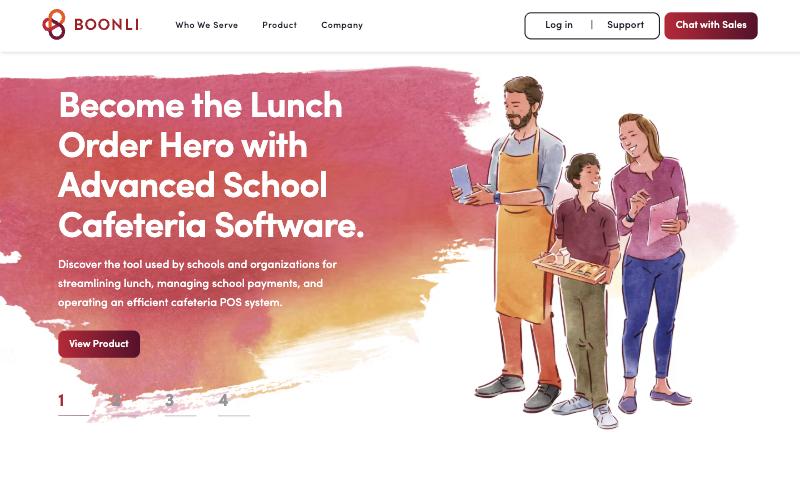
Boonli calls itself “the platform that connects schools, parents, and their food partners,” and its homepage pitches school lunch software with ordering, payments and a cafeteria point of sale. If your food comes from an outside caterer rather than your own kitchen, that’s the fit its words describe.
Pros
- Connects schools, parents and outside food partners, per its own words
- Ordering and payments for lunch plus other school payments
- Serves both school administrators and caterers
Cons
- Its pages don't describe operator-configured subsidies
- Its pages don't describe production by school, class and teacher for a commissary kitchen
- Its pages don't describe French
- No public price list
Pricing: none published on its pages as of November 2026.
5. MunchaLunch, best for parent-council hot lunch days and fundraising
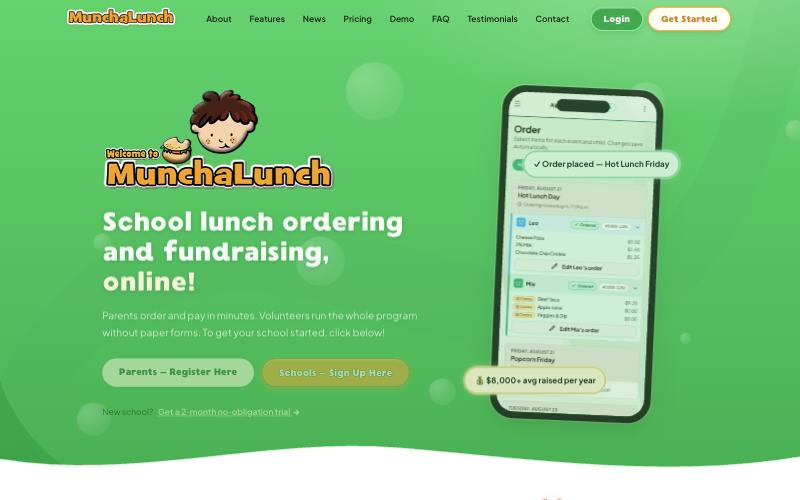
MunchaLunch is “an Online Ordering System for school lunches & fundraising,” hosted in Canada, where parents order and pay while volunteers run the program. Its treasurer reports break a program down by revenue, card fees, vendor costs and profit, which is exactly what a parent council hands to its school.
Pros
- Published flat pricing: $330 per school per school year, all features included
- Fundraising reports with revenue, card fees, vendor costs and profit
- Hosted in Canada, with a 2-month no-obligation trial
Cons
- Built for volunteer-run hot lunch days, not an operator's daily meal program
- Its pages don't describe operator-configured subsidies or commissary production
- Its pages don't describe French on the ordering side
Pricing: $330 per school per school year, as its page states it, with no tiers.
6. Healthy Hunger, best for restaurant lunch days that fund the school
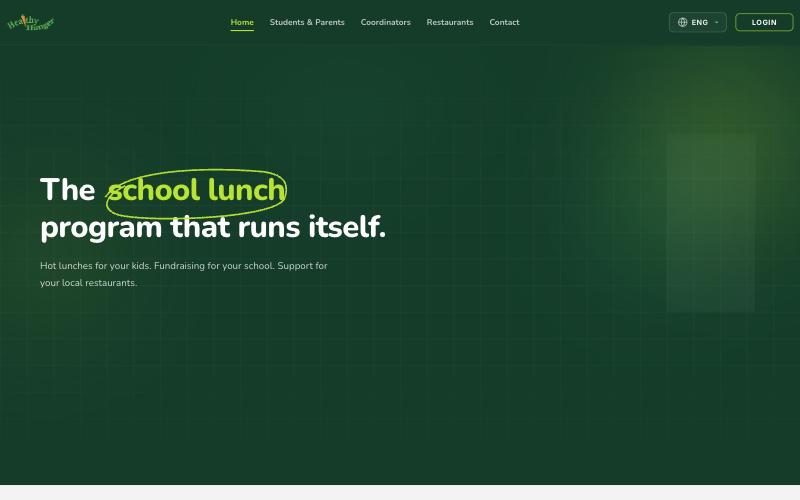
Healthy Hunger calls itself “The school lunch program that runs itself,” across hundreds of schools from BC to Nova Scotia. Its page says it is free for schools always, funded by its restaurant partners, and its language menu includes French.
Pros
- Free for schools, funded by its restaurant partners, per its page
- Fundraising flows back to the school on every lunch day
- French appears in its site's language menu
Cons
- A restaurant lunch-day model, not an operator's own kitchen and menus
- Its pages don't describe operator-configured subsidies or per-class production reporting
- The menu is the restaurant partners' menu, not yours
Pricing: free for schools, per its page; the restaurants fund the program.
The quick comparison
| Product | Built for | Published pricing (as of November 2026) |
|---|---|---|
| Nutrislice | Menus, signage, labels and ordering across many kinds of dining | None found on its pages |
| Rally Schools | Operator-run paid and subsidized meals across many schools | Flexible: subscription scoped to the program |
| LINQ Connect | US district accounts, fees and meal applications | None found on its pages |
| MySchoolBucks | Family payments for cafeteria and school fees | None found on its pages |
| Boonli | Menus and ordering with an outside food partner | None found on its pages |
| MunchaLunch | Parent-council hot lunch days and fundraising | $330 per school per school year |
| Healthy Hunger | Restaurant lunch days that fund the school | Free for schools; funded by restaurant partners |
One note on French, since it decides deals in Canada: of the pages we read, Healthy Hunger’s offers French in its language menu, and MySchoolBucks offers English, Spanish, Arabic and Vietnamese. We can only say what each page shows.
What we meet in deals, as App8’s view: Nutrislice most often, usually compared on pre-ordering for K-12. We also meet operators who plan to build their own ordering form, and the ordering screen is the easy part. The work sits behind it: allergens, subsidies and their reporting, production sheets, and many schools served from one kitchen, which is the whole subject of our school lunch ordering guide.
Who should stay on Nutrislice
In App8’s view, in plain terms:
- Districts whose main need is menus, nutrition information, signage and labels for students and families.
- Districts that run Nutrislice beside a district nutrition system they’re happy with, for eligibility, meal accounts and the point of sale.
- Dining programs that span schools, campuses, hospitals and workplaces and want one menu tool for all of them.
What Rally Schools does that Nutrislice’s pages don’t describe
Rally Schools is built for the operator running paid and subsidized meals across many schools. The honest framing is what it does that Nutrislice’s pages don’t describe, never that Nutrislice lacks it.
| Rally Schools | Nutrislice, from its own pages | |
|---|---|---|
| Subsidies | Operator-configured: full subsidy by default with a parent opt-out to pay, a sliding scale that starts fully subsidized, or subsidized prices on chosen items. A subsidy goes to every family or only to families with a code; the operator and its funder decide who gets a code, and App8 doesn’t determine eligibility. The operator can cap subsidized meals per account per day, and every order reports as subsidized or paid | Not described on its K-12 or ordering pages |
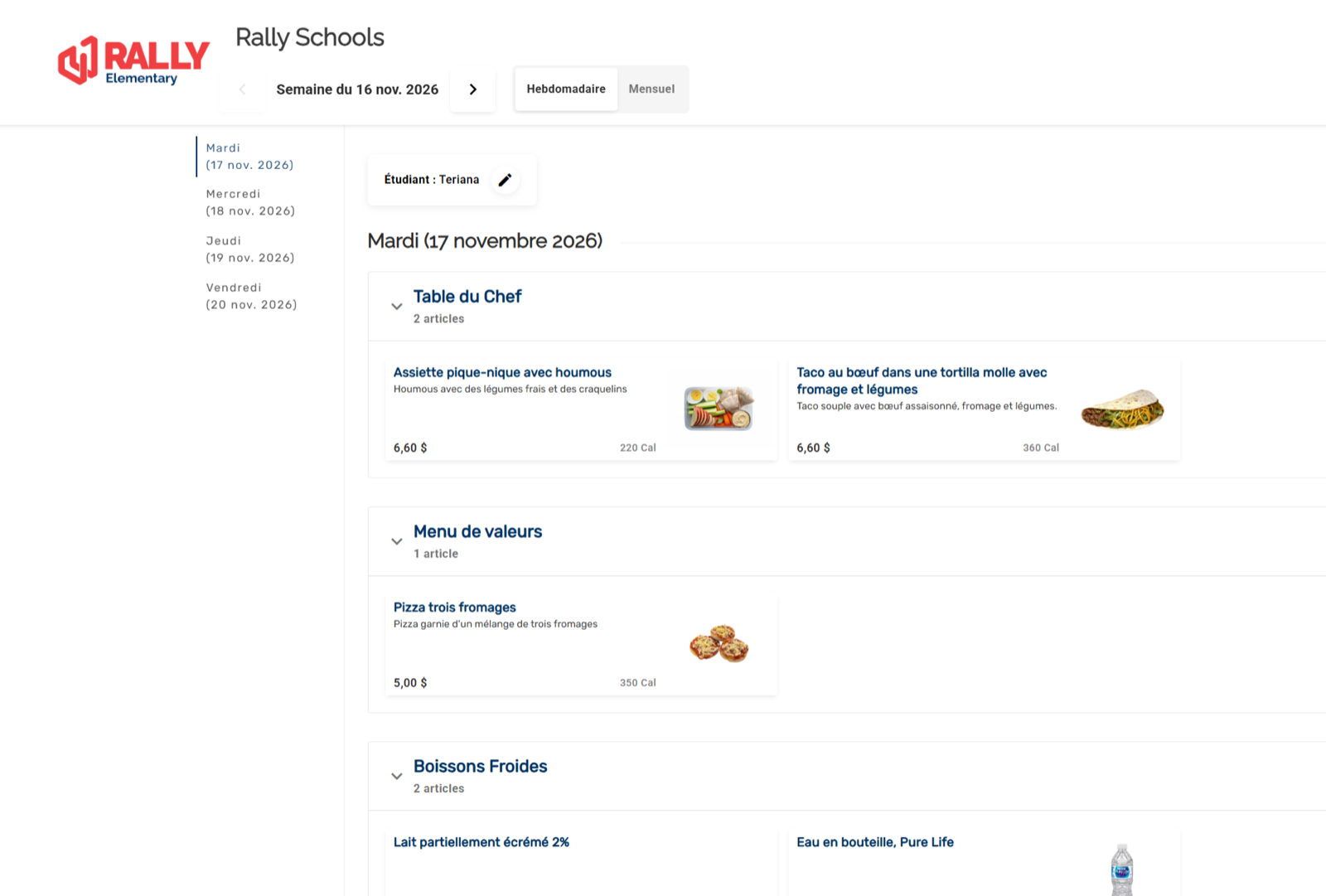
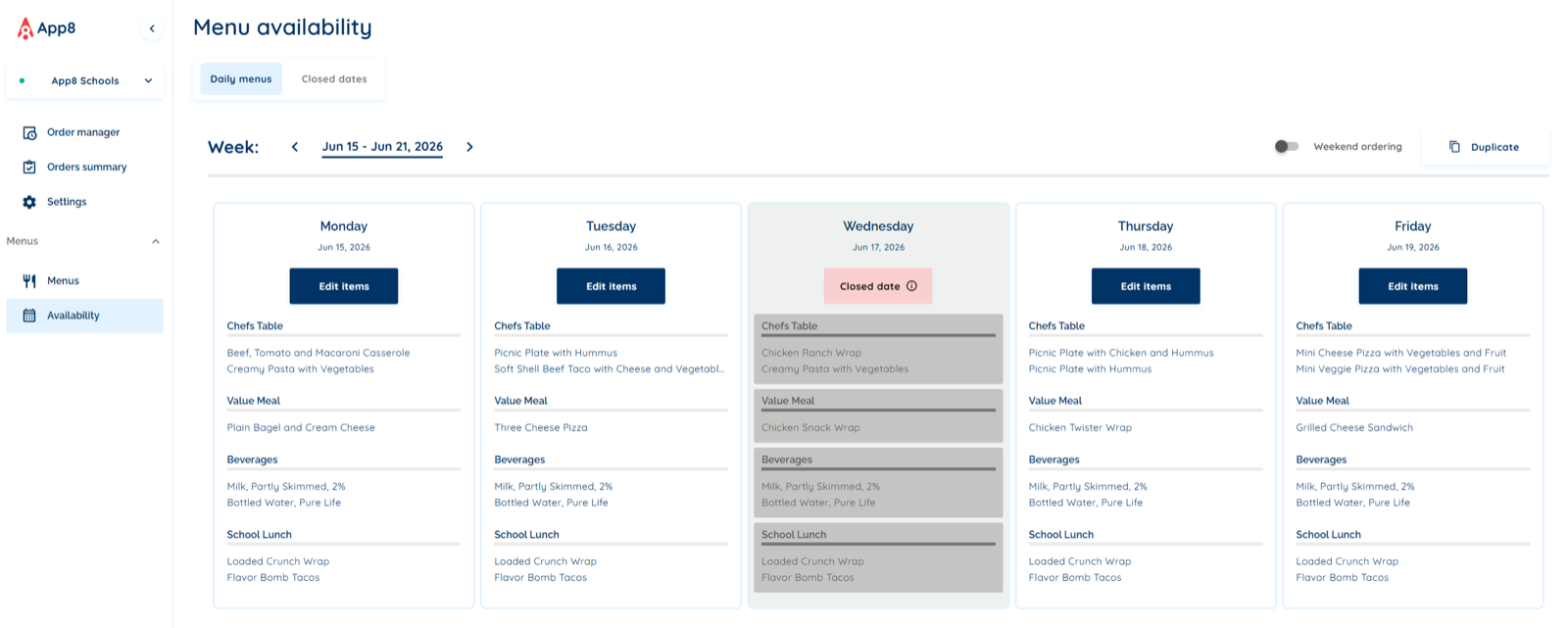
| Parent accounts | A parent saves a profile for each child (name, class, grade and teacher) and orders for each child from a calendar, and can add one meal type across many days at once | Parents named as an audience for menus; accounts not described |
| Languages | English and French, on the menus families see and on the operator’s side, written to meet Quebec’s French-language requirements under Bill 96. Support also works in French | Its app listing mentions “50+ languages”; French not named |
| Payments | App8 is certified to PCI DSS Level 1, and the payment providers App8 uses are PCI certified. When an order is canceled, the family can get a credit instead of a refund and use it on future orders; the operator sets when credits expire, by school year | ”Offer Diverse Payment Options”; no provider named |
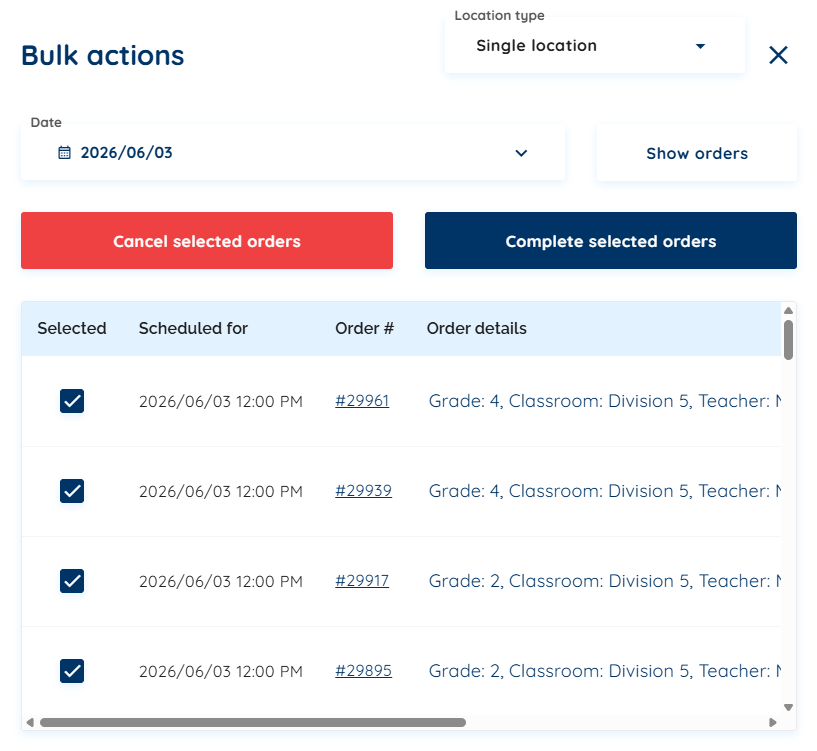
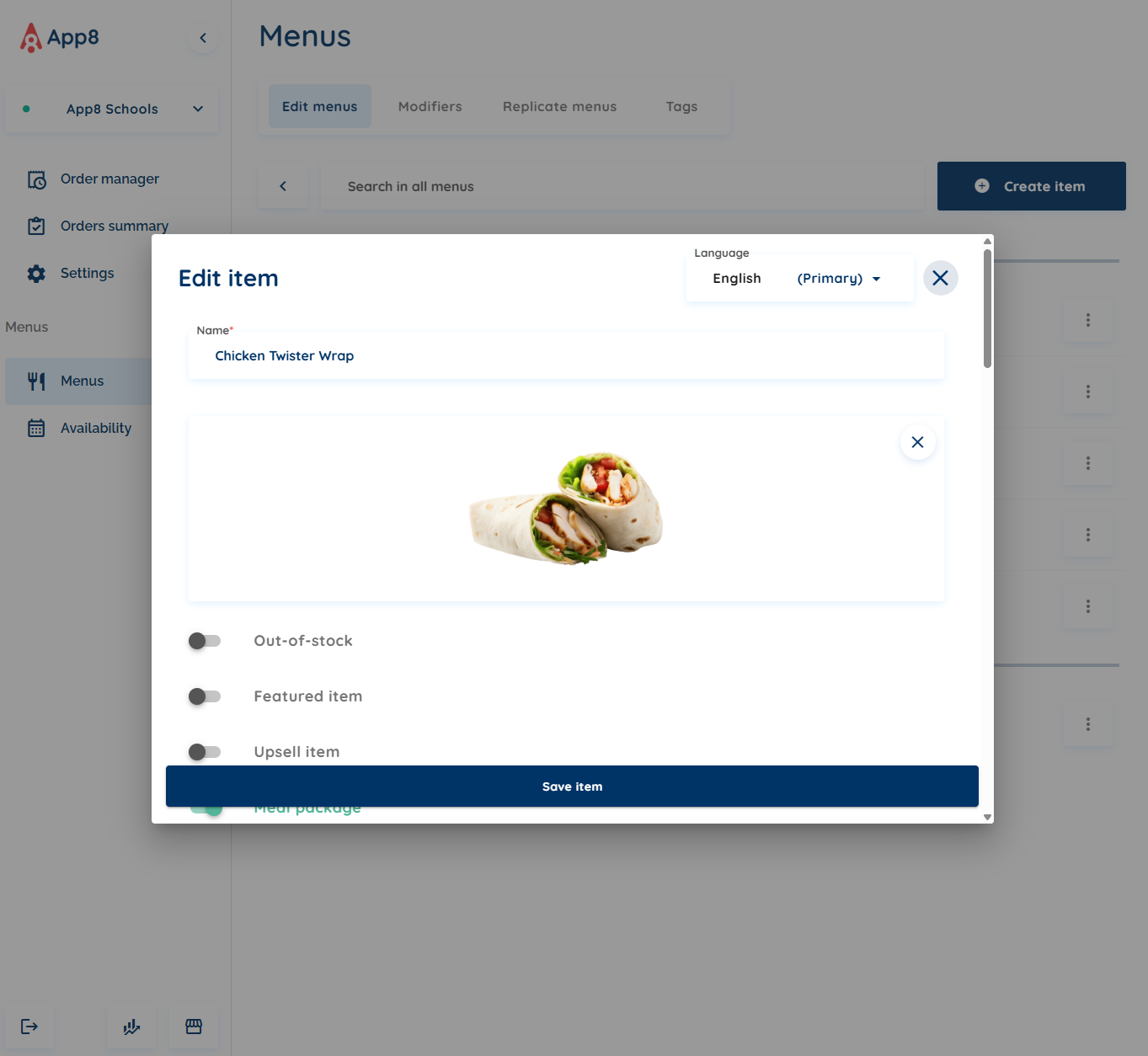
| The operator’s side | One account runs many schools, each with its own teachers, classes and grades, so one commissary kitchen can cook for several schools. Production and order reports by student, class and teacher, actions in bulk across a day’s orders, and tax and accounting categories set per item and per option | Order queue, order and item-count reports, pickup windows and throttling |
The family side of that, in the demo screens (the students, menus and prices are made up):
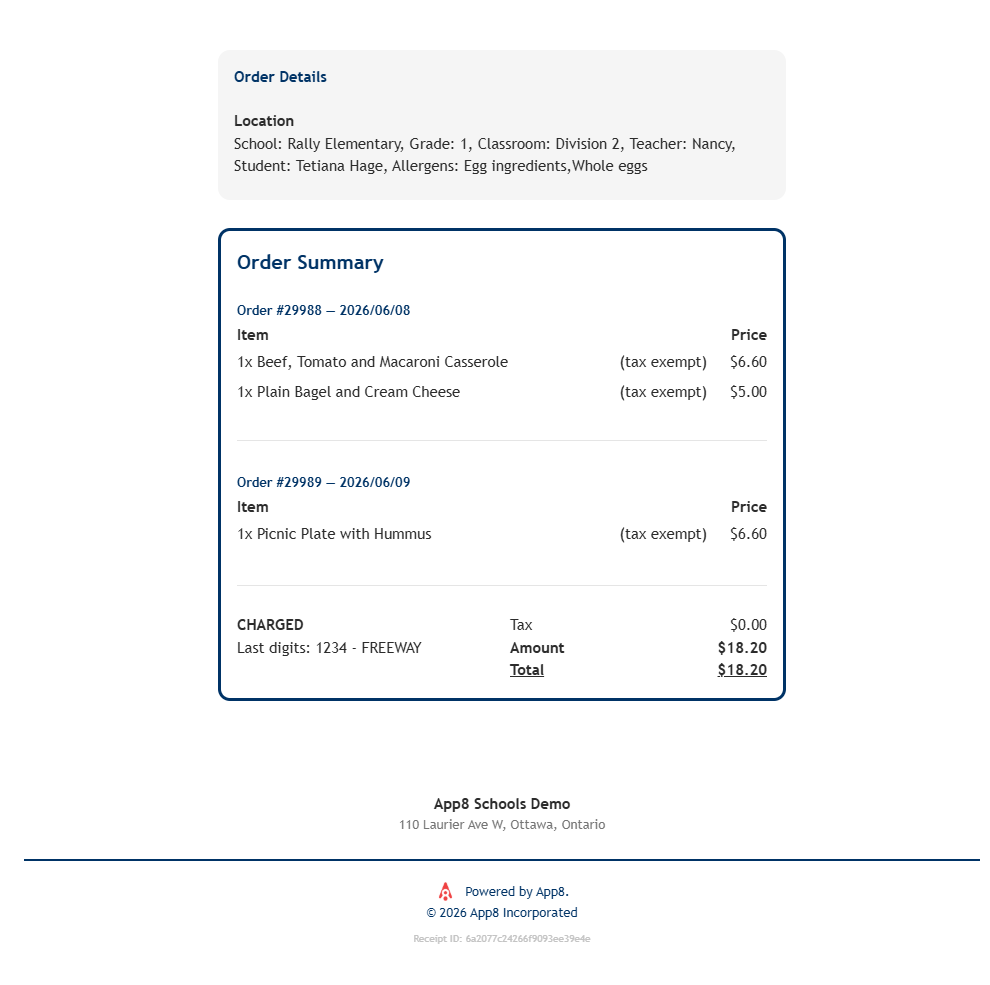
And the operator’s side, which is where school programs are actually won or lost:
On credits, one more detail worth naming: when a school order is canceled, the family can get a credit instead of a refund and use it on future orders, with the operator setting when credits expire, by school year. In App8’s view that spares the finance team refund processing and its fees.
Switching without retyping a term’s menus
Two facts, stated plainly. App8 has replaced Nutrislice for a school foodservice operator; we have nothing else cleared to say about it, so we’ll say nothing else. And Rally Schools imports menus from a structured CSV file, handling English and French menus and accounting categories, so an operator doesn’t retype a term’s menus; App8 first built that import to bring menus over from Nutrislice.
If your program is school meals at operator scale, the full requirements picture, subsidies, cutoffs, production and board review included, is in our school lunch ordering guide. If your dining program also spans a workplace cafeteria, that side of the stack has its own post, and the wider software field is mapped in our CaterTrax guide.
Frequently asked questions
What is Nutrislice?
Nutrislice describes itself as digital menus, signage, food labels, and ordering in one streamlined platform for foodservice. It serves corporate dining, higher education, K-12 and healthcare, was founded in 2011, and describes itself as empowering over 30,000 locations, with its K-12 page citing 25,000+ schools. Its ordering page lists multi-day pre-ordering, pickup windows, throttling orders at peak times, meal customization, and pickup or delivery.
What are the best Nutrislice alternatives for schools?
It depends on the program. A US district that needs meal accounts, school fees, meal applications and eligibility in one system should look at district nutrition and payment systems such as LINQ's family portal or MySchoolBucks. A school that wants menus and ordering in front of families can look at Boonli alongside Nutrislice. A parent council running a hot lunch day, common in Canada, fits MunchaLunch or Healthy Hunger. And an operator running paid and subsidized meals across many schools, with a commissary kitchen and operator-configured subsidies, is the buyer App8's Rally Schools is built for.
Who should stay on Nutrislice?
In App8's view: districts whose main need is menus, nutrition information, signage and labels for students and families; districts that run Nutrislice beside a district nutrition system they're happy with for eligibility, meal accounts and the point of sale; and dining programs that span schools, campuses, hospitals and workplaces and want one menu tool for all of them.
Does Nutrislice handle subsidized school meals?
Its K-12 and ordering pages don't mention subsidies, so that's a question to ask in a demo rather than something we can answer from its pages. For comparison, Rally Schools runs operator-configured subsidies: full subsidy by default with a parent opt-out, a sliding scale that starts fully subsidized, or subsidized prices on chosen items, with every order reporting as subsidized or paid. App8 doesn't determine eligibility, and its product page says plainly that App8 does not determine eligibility or manage federal reimbursement.
Does Nutrislice work in French?
Its app listing says menus can be browsed in 50+ languages, but its pages don't name French or describe French on the operator's side, so ask in a demo if French matters to your program. Rally Schools runs in English and French on the menus families see and on the operator's side, written to meet Quebec's French-language requirements under Bill 96, and App8's support also works in French.
Can an operator switch from Nutrislice without retyping its menus?
Rally Schools imports menus from a structured CSV file, so an operator doesn't retype a term's menus, and the import handles English and French menus and accounting categories. App8 first built that import to bring menus over from Nutrislice, and App8 has replaced Nutrislice for a school foodservice operator.