
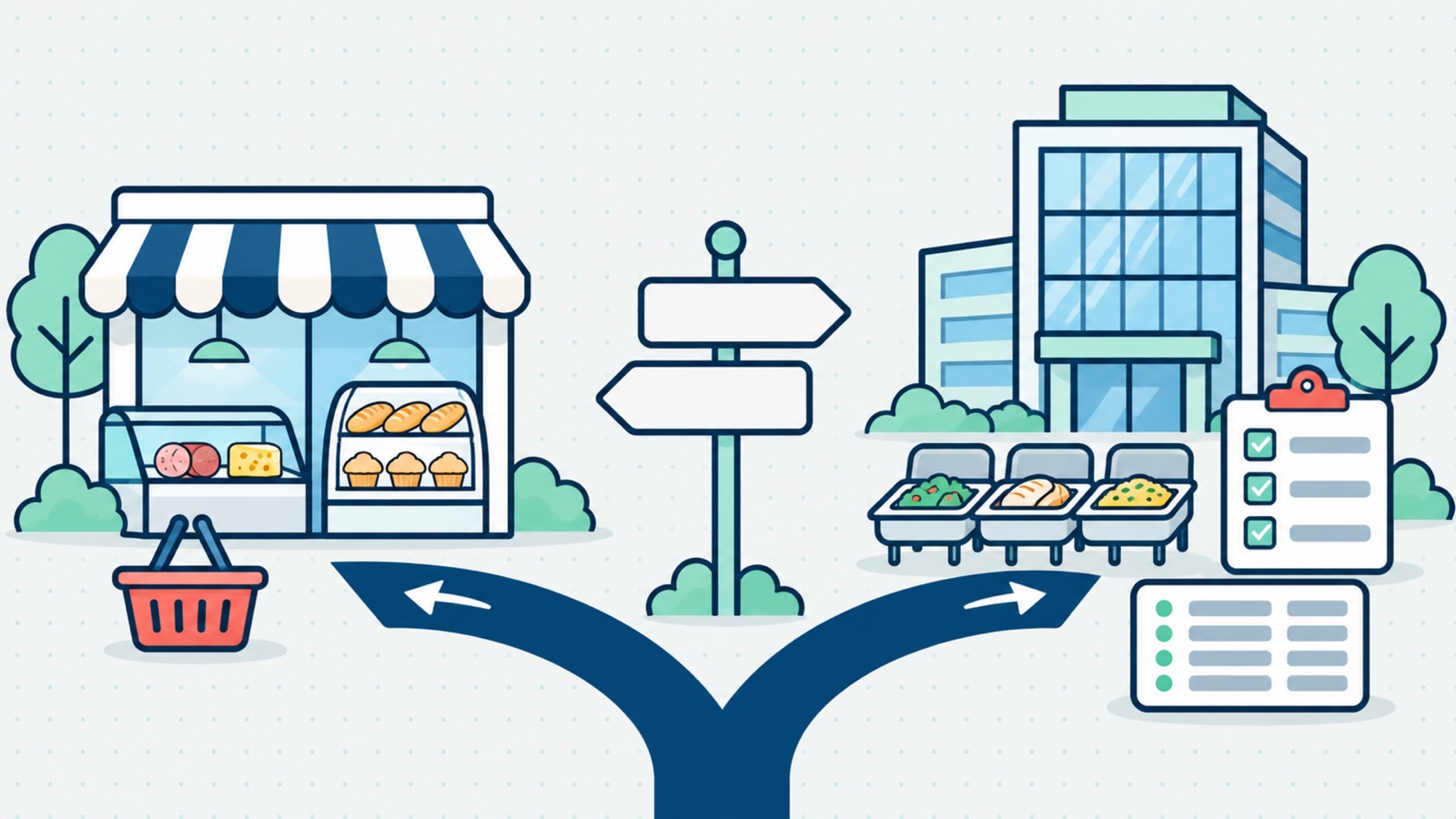
FoodStorm alternatives is really two different searches wearing one keyword, and sorting that out early saves everyone time. FoodStorm is built for grocery stores: its home page leads with “Maximize your grocery perimeter counters”, and its catering page says the platform “is designed for the unique needs of grocery catering departments.” If you run a grocery chain’s deli, bakery and catering counters, it may suit you best, and this guide will say so plainly. If you’re a caterer or a foodservice operator running catering for client companies, you’re the reader the rest of this guide is for.
TL;DR
- Who FoodStorm is: grocery-built catering software, acquired by Instacart in 2021, powering the order management system in Instacart’s enterprise suite.
- Where we actually meet it: rarely, because it sells to a different buyer than foodservice platforms do.
- The demo questions for non-grocery buyers: corporate catering events, client billing, single sign-on and languages.
- The 7 best alternatives, each with pros, cons and published pricing, and who should stay.
- The side-by-side with App8’s Rally Catering, every FoodStorm cell from its own pages.
The short version:
| If you run | Look at |
|---|---|
| Grocery deli, bakery, floral and holiday catering counters | FoodStorm, and other grocery-built tools |
| Catering for client companies across many sites | CaterTrax, or App8’s Rally Catering |
| A catering business with drop-off and full-service events | CaterZen, Caterease, or Total Party Planner |
| Events at a restaurant, hotel or venue | Tripleseat |
| A restaurant taking catering orders through a marketplace | ezCater’s restaurant tools |
What FoodStorm is, in its own words
FoodStorm’s use cases, as of November 2026, are made-to-order and foodservice, deli ordering, holiday catering, grocery catering, custom cakes and bakery ordering, and floral. It lets a retailer “Set up multiple store locations and departments”, offers “reporting tools, including multi-location reporting”, and says “Integrate with your preferred point-of-sale.”
Its home page says setup takes “as little as 4-8 weeks”, and it publishes no pricing. Instacart announced its acquisition of FoodStorm in October 2021, and FoodStorm’s home page says it “powers the Order Management System (OMS)” of Instacart’s enterprise suite.
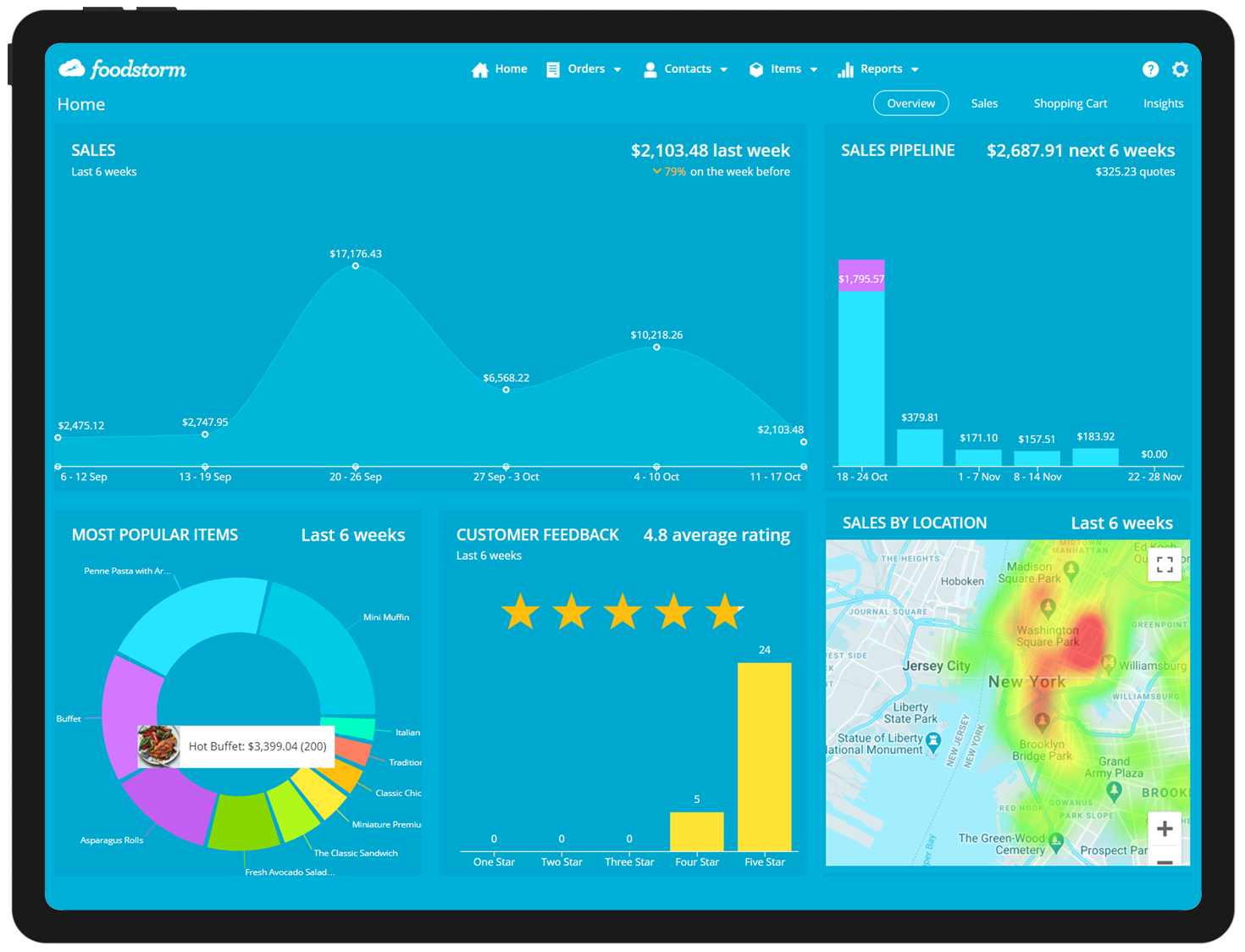
Where FoodStorm sits in enterprise catering deals
In App8’s view: rarely on the same shortlist. FoodStorm is built for grocery stores, with orders placed ahead and picked up in store, while App8 sells to foodservice operators running catering for client companies, campuses and venues.
That’s not a criticism, it’s a map. A grocery reader can leave this post early and be better for it; a foodservice reader should keep reading, because the real question is what a client-company catering program needs that grocery-built software has no reason to describe.
What its pages don’t describe
For a foodservice operator running catering for client companies, four things decide whether software fits, and FoodStorm’s pages don’t describe them. Write them down as demo questions, never as things it can’t do.
- Corporate catering events. Inquiries, quotes the client accepts online or confirms with a deposit, and banquet event orders (BEOs). Its pages don’t mention events or BEOs.
- Billing client companies. Each order carrying the department’s cost center or PO number, invoices on terms, and payments reconciling into the operator’s accounting system. Its pages name a point-of-sale connection; they don’t describe invoicing, accounting or ERP connections, which is its own discipline.
- Single sign-on and access by role. Single sign-on lets the client’s employees use their work account, and roles control who sees what across sites. Its pages don’t describe either.
- Languages. Its pages state none.
The 7 best FoodStorm alternatives for foodservice catering
The entries are numbered for reading order, not ranked: every tool here has its place, each is described from its own pages as of November 2026, and the right pick depends on the business you run. In App8’s view, a grocery chain that wants order-ahead at its deli and bakery counters should look first at grocery-built tools, FoodStorm among them, and can skip this list entirely.
1. Rally Catering, best for catering for client companies across many sites
Rally Catering is App8’s catering platform for foodservice operators: everyday orders employees place themselves, corporate catering events with quotes and BEOs, and billing that reconciles into the operator’s accounting system. The full side-by-side with FoodStorm is below.
Pros
- Client billing: credit card, invoice, or house account on net terms, with cost center or PO checked at checkout
- Corporate catering events from inquiry to quote to BEO, in the same system as everyday orders
- Orders reconcile into the operator's accounting system, category, cost center and PO intact
- English and French, for guests and on the operator's dashboard
- Flexible pricing: a subscription scoped to each program, with no fee per user and no commission on orders
Cons
- Built for foodservice operators, not grocery counters
- No floor plans, staff scheduling, rentals or e-signature contracts
- No published rollout time
Pricing: flexible by design. A fixed platform subscription scoped to each program, billed monthly or annually, with no fee per user and no commission on orders, so the number depends on the program rather than the headcount. The place to get yours is a demo.
2. CaterTrax, best for contract-foodservice back offices
CaterTrax is a catering and hospitality ordering platform built by caterers, sold in Independent and Enterprise tiers, and it’s the product most contract-foodservice operators have already met. Our CaterTrax guide covers it at full length, including when we’d tell you to stay on it.
Pros
- Built for contract-foodservice operations, with a large installed base
- Its homepage publishes real scale: 5,000+ client locations and 5 million+ orders a year
- Separate tiers for single sites and multi-location brands
Cons
- Operators report menu changes route through the vendor's team rather than self-serve
- Seats and support packages carry their own costs, per operators running it
- No pricing published on its site
Pricing: not published on its site as of November 2026; Capterra lists US$150 starting, billed per feature.
3. CaterZen, best for a single-site caterer growing drop-off and full-service work
CaterZen describes catering software for drop-off, full-service and event space businesses, with sales and marketing tools built in. It publishes its pricing in full, which this category rarely does.
Pros
- Published pricing with unlimited users and orders on its plans
- Drop-off, full-service and event space work in one product, per its pages
- Marketing tools for growing a catering book, on its upper plans
Cons
- Built around a catering business, not a multi-site client-company program
- Its pages don't describe cost centers, PO billing or single sign-on
- A $499 one-time start-up investment applies, more past 5 locations
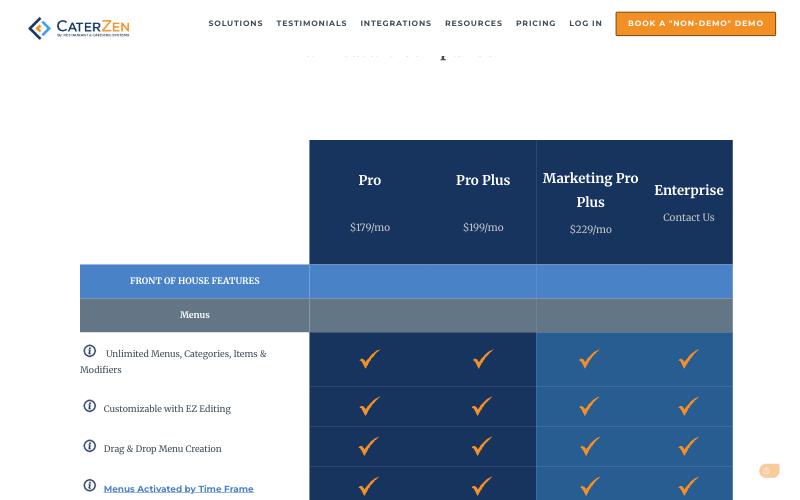
Pricing: Pro at $179 a month, Pro Plus at $199, Marketing Pro Plus at $229, Enterprise by quote, plus a $499 one-time start-up fee for up to 5 locations, as its pricing page states as of November 2026.
4. Caterease, best for event-centered catering operations
Caterease positions itself as software for catering and event management, from leads and layouts to staffing and payments. It also publishes pricing, per-user fees included, so the math is easy to run before a demo.
Pros
- Published pricing across three plans, with add-on modules priced too
- Event management depth: prints, layouts, payments and program add-ins
- Connects to floor plan and seating tools
Cons
- Per-user pricing at $28 a month adds up for a large operator team
- A one-time $200 per-user launch fee applies on all plans
- Its pages don't describe client-company billing mechanics like cost centers and POs
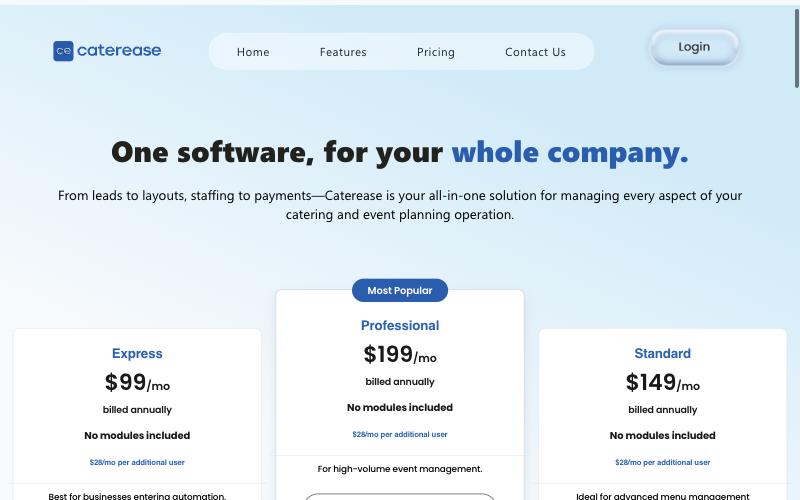
Pricing: Express $99, Standard $149, Professional $199 a month billed annually, $28 a month per additional user, a $200 per-user launch fee, and $25 a month per add-on module, as of November 2026. Our Caterease guide has the full picture.
5. Total Party Planner, best for events-first caterers on proposals and BEOs
Total Party Planner is catering software built by caterers, centered on proposals, contracts, deposits, BEOs, staff and room layouts, with QuickBooks compatibility. It has its own guide with the full pricing breakdown.
Pricing, in short: three plans from $119 to $429 a month with one to three users included, online ordering as an add-on, $25 a month per extra user, and a one-time $299 setup fee, as its pricing page states as of November 2026.
6. Tripleseat, best for events at restaurants, hotels and venues
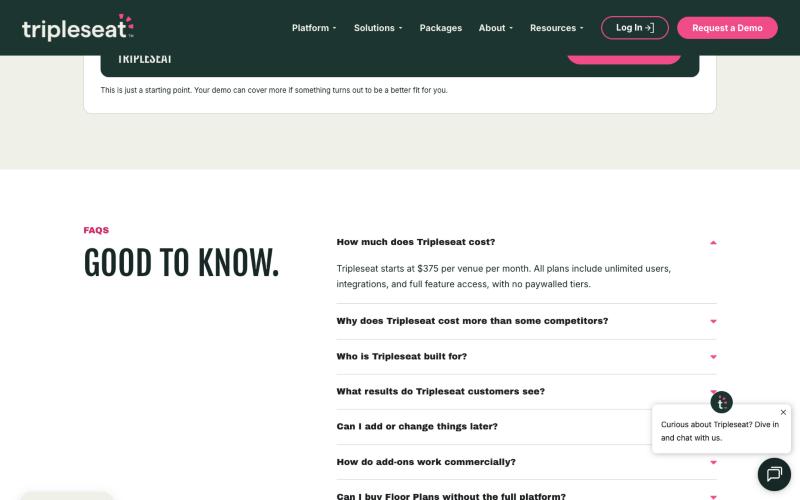
Tripleseat is event management software for restaurants, hotels and venues: leads, proposals, room blocks and event execution. Its packages page answers the cost question directly, which is rare in events software.
Pros
- Published starting price with unlimited users and full feature access
- Built for venue and restaurant event sales, room blocks included
- Floor plans and self-serve booking available as add-ons
Cons
- Venue-centered: its pages describe event bookings, not daily catering order operations
- Its pages don't describe client-company billing with cost centers or POs
- Per-venue pricing should be modeled across a multi-site program
Pricing: starts at $375 per venue per month, with all plans including unlimited users, as its packages page states as of November 2026.
7. ezCater’s restaurant tools, best for marketplace catering orders
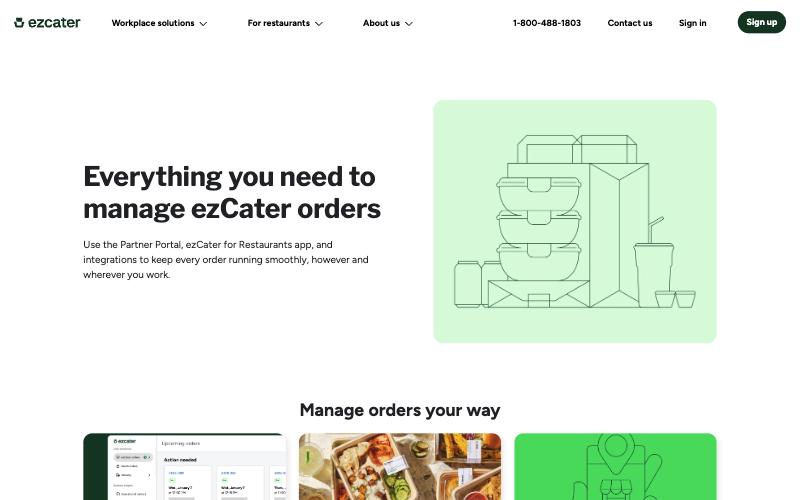
ezCater is a catering marketplace, and its restaurant page describes “Everything you need to manage ezCater orders”: the partner portal, an app and integrations. It’s a different thing from software you run, which is exactly why it fits a restaurant that wants orders brought to it.
Pros
- Brings corporate catering demand to the restaurant through its marketplace
- Partner portal, app and integrations to manage incoming orders
- No platform of your own to set up and run
Cons
- A marketplace, not software an operator runs for its own clients
- The client relationship and storefront sit with the marketplace
- No software price list; commercial terms come with the partnership
Our deeper comparisons of this field are the CaterTrax, Caterease and Spoonfed guides.
Who should stay on FoodStorm
In App8’s view:
- Grocery retailers running deli, bakery, floral and holiday catering orders across their stores.
- Retailers selling through Instacart, since FoodStorm’s home page says it powers the order management system in Instacart’s enterprise suite.
- Stores taking orders for their deli, bakery and catering counters, which its use cases describe; its home page also names a kitchen display system and pickup management.
FoodStorm vs Rally Catering: what we can state publicly
Every FoodStorm cell is from its own pages, as of November 2026. Where a cell says “not described”, that means we didn’t find it on its pages, not that it doesn’t exist.
| FoodStorm | App8 (Rally Catering) | |
|---|---|---|
| Built for | ”grocery catering departments” | Foodservice operators running catering across many sites, much of it for client companies |
| Finance and accounting | Not described | Once the operator’s accounting connection is set up, orders reconcile into its accounting system, each receivable to the right category, cost center and PO, with JD Edwards as the named example. Other ERPs connect through the enablement team, scoped to the program |
| Client billing | Not described | Credit card, invoice, or a house account on net terms. Cost center or PO checked at checkout against the operator’s rule |
| Corporate catering events | Not described | Inquiry, quote the client accepts online or confirms with a deposit, and a BEO, in the same system as everyday orders |
| Reporting | ”multi-location reporting” | Revenue, volume, customer mix, item performance and program participation, printable and exportable |
| Languages | Not described | English and French, for guests and on the operator’s dashboard |
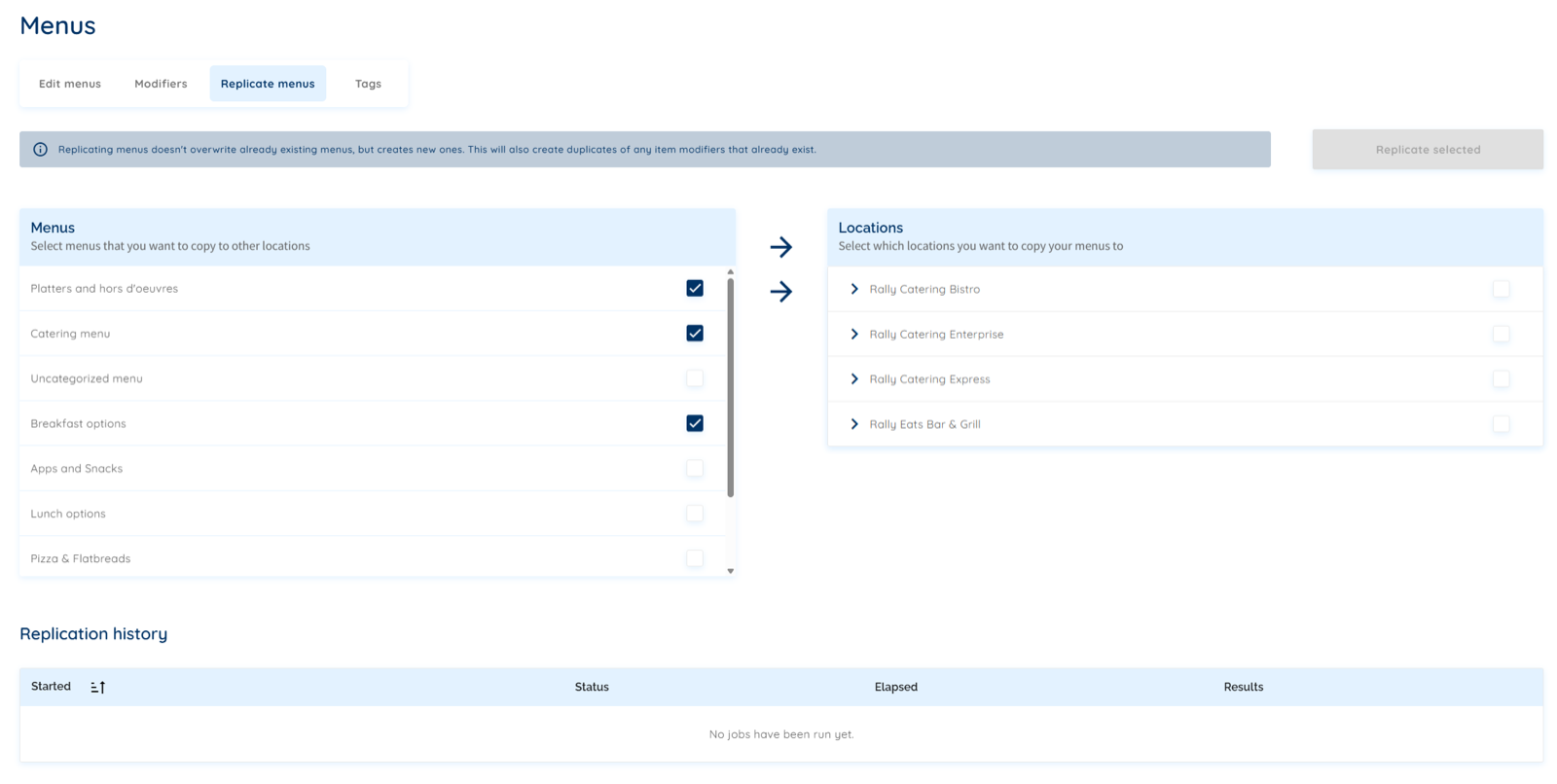
| Rollout | ”Setup in as little as 4-8 weeks” | Enterprise implementation and enablement, with menus set up once and copied to other locations. We don’t publish a rollout time |
| Pricing | Not published on its home page | A fixed platform subscription scoped to each program, billed monthly or annually, with no fee per user and no commission on orders. No public price list |
| Company | Instacart announced its acquisition in October 2021 | App8 Inc., Ottawa, Canada |
On the rollout row, here’s what “menus set up once and copied” looks like, from App8’s demo site:
The honest close: FoodStorm does well what its pages say it does, for the grocery business it names. If that’s you, evaluate it there. If you run catering for client companies across many sites, start with the four demo questions above and what a catering management system has to do, because the work that decides your program lives behind the ordering screen.
Frequently asked questions
What is FoodStorm?
FoodStorm is catering software built for grocery stores. Its home page leads with maximizing grocery perimeter counters, its catering page says the platform is designed for the unique needs of grocery catering departments, and its use cases cover made-to-order and foodservice, deli ordering, holiday catering, grocery catering, custom cakes and bakery ordering, and floral. Instacart announced its acquisition of FoodStorm in October 2021, and FoodStorm's home page says it powers the order management system of Instacart's enterprise suite.
Who should stay on FoodStorm?
In App8's view: grocery retailers running deli, bakery, floral and holiday catering orders across their stores; retailers selling through Instacart, since FoodStorm's home page says it powers the order management system in Instacart's enterprise suite; and stores taking orders for their deli, bakery and catering counters, which its use cases describe, with a kitchen display system and pickup management named on its home page.
What are the best FoodStorm alternatives?
It depends on which business searched for it. Catering for client companies across many sites points to CaterTrax or App8's Rally Catering. A catering business running drop-off and full-service events fits CaterZen, Caterease or Total Party Planner. Events at a restaurant, hotel or venue fit Tripleseat. A restaurant taking catering orders through a marketplace can use ezCater's restaurant tools. And in App8's view, a grocery chain that wants order-ahead at its deli and bakery counters should look first at grocery-built tools, FoodStorm among them.
Does FoodStorm handle corporate catering events and client billing?
Its pages don't describe either, so treat both as demo questions rather than answers. Its pages don't mention events or banquet event orders, and they name a point-of-sale connection without describing invoicing, accounting or ERP connections, cost centers or PO numbers. For an operator running catering for client companies, those are the mechanics the program runs on, which is why they head our question list.
How long does FoodStorm take to set up?
Its home page says setup takes as little as 4 to 8 weeks. App8 doesn't publish a rollout time for Rally Catering; enterprise implementation runs with its enablement team, and menus set up once can be copied to other locations rather than rebuilt.